The Simplest Strong Game in the Casino
Baccarat has a curious reputation — associated with high rollers and tuxedos — while being mechanically the simplest casino game there is. Two hands are dealt, the banker and the player, and you bet on which comes closer to nine. No decisions after the bet, no strategy charts, no skill ladder. And the maths is kind: the banker bet carries a 1.06% house edge, second only to blackjack in the entire casino. For a beginner who wants strong odds without memorising strategy, nothing beats it.
The Rules in Two Minutes
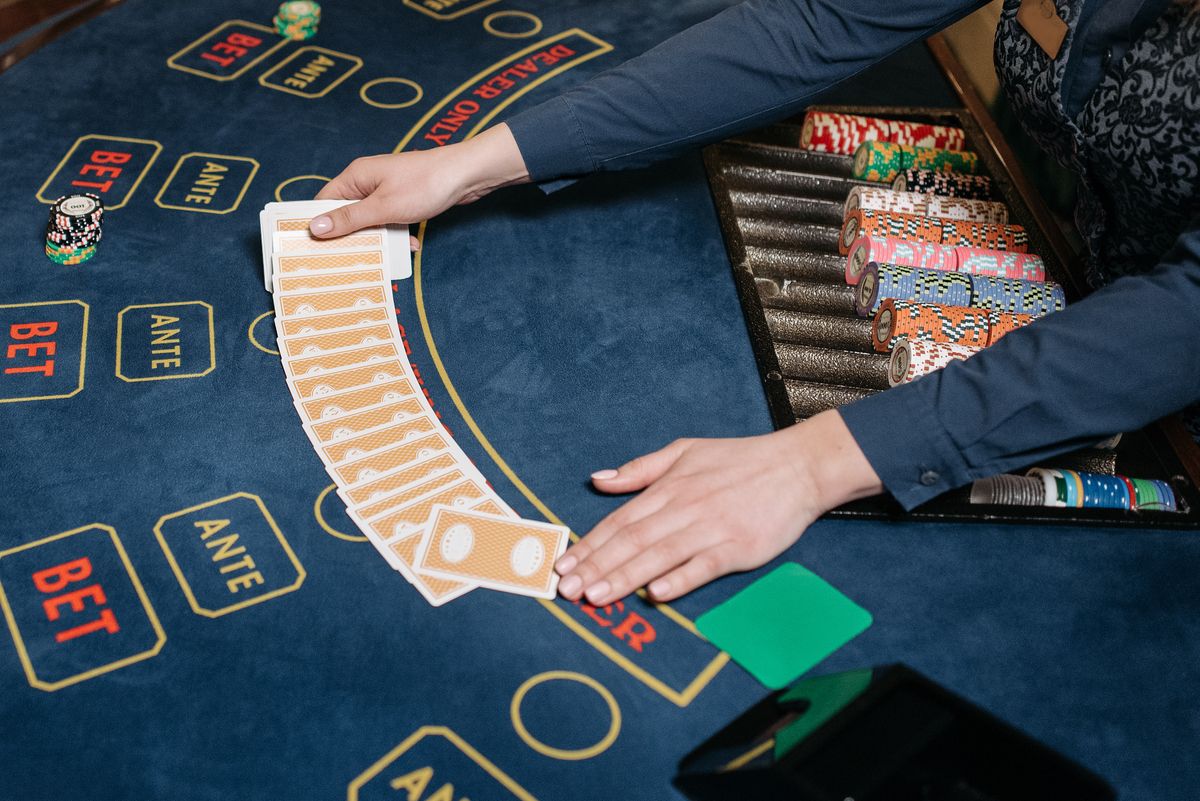
Cards are valued simply: aces count 1, cards 2–9 count face value, and tens plus face cards count zero. Two cards are dealt to each hand; the values are added, and only the last digit counts — a 7 and an 8 make 15, which counts as 5. The hand closer to 9 wins. A third card may be dealt to either hand according to a fixed table of rules — neither you nor the dealer makes any choice. The game plays itself; you only bet on the outcome.
- Aces = 1; 2–9 = face value; 10/J/Q/K = 0
- Totals wrap at nine: 15 counts as 5
- Third-card rules are automatic — no decisions
- Closest to 9 wins; equal totals are a tie

The Three Bets — and the One to Avoid
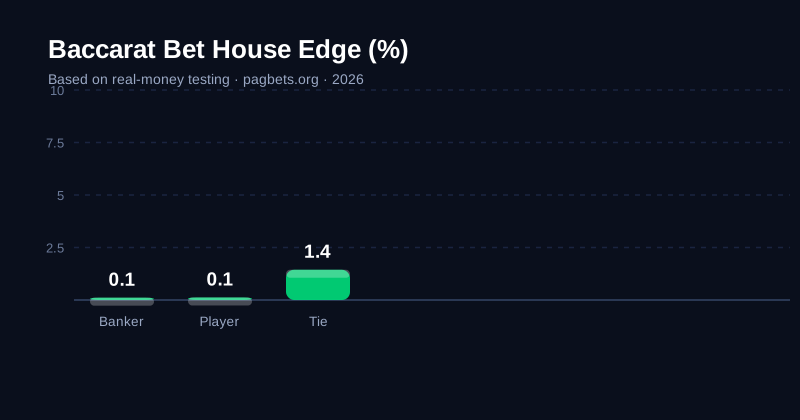
The table offers three bets with three very different prices. Banker wins about 45.9% of rounds and pays even money minus a 5% commission — net edge 1.06%. Player wins 44.6% and pays even money with no commission — edge 1.24%. Tie pays a tempting 8:1 but happens only 9.5% of the time — edge 14.4%. The strategy is simply: bet banker every hand, accept the commission as the price of the best odds, and never touch the tie. That one sentence is the complete baccarat strategy.
| Bet | Win probability | Payout | House edge |
|---|---|---|---|
| Banker | 45.9% | 1:1 minus 5% | 1.06% |
| Player | 44.6% | 1:1 | 1.24% |
| Tie | 9.5% | 8:1 | 14.4% — avoid |
The Commission Question
The 5% commission confuses newcomers, and it's worth understanding: the banker hand wins more often than it loses, so without the commission, betting banker would be a winning bet — the casino's entire edge would be negative. The commission rebalances it. Modern casinos also offer no-commission baccarat, which removes the 5% but changes the banker payout to 1:2 when the banker wins with exactly 6 — a rule that pushes the edge to about 1.46%. Standard baccarat with the commission remains the better deal.
Baccarat Systems: Same Truth as Roulette
Baccarat attracts betting systems — following the shoe, martingale progressions, streak betting — and they all share the same mathematical fate as roulette systems: the house edge is fixed at the moment of each bet, and no pattern of stakes changes it. The cards have no memory, and the shoe's history predicts nothing. The only genuine decision in baccarat is the one covered above: banker, flat stakes, never the tie. Our roulette guide explains the systems' shared failure in depth.
Playing Baccarat Online
Online baccarat comes as RNG games (fast, from tiny stakes) and live dealer tables (real cards, real pace — the authentic experience). Live baccarat at Stake and 22Bet runs around the clock with low minimums. Flat-bet 1–2% of your session budget on banker, time-box the session, and baccarat becomes what it should be: a relaxed, low-cost game with odds nearly as good as blackjack and none of the homework.
Related reading: our Baccarat Betting Strategy guide covers the same ground from a different angle.
Related reading: our Three Card Poker guide covers the same ground from a different angle.
Shoe Size, Pairs and Why Eight Decks Is Standard
The number of decks in the shoe changes the baccarat mathematics in small, predictable ways, and it is worth knowing before you sit down. More decks push the tie probability slightly higher — around 8.4% with eight decks against roughly 8.1% with six — which makes the tie bet marginally worse with a full shoe. The house edge on banker and player barely moves, but the reason live casinos use eight decks is procedural: fewer reshuffles, longer sessions, less time for the dealer to be interrupted.
A consequence follows that many players ignore. With more cards dealt before a shuffle, an unusually long run of banker or player wins becomes more likely in any given session than the long-run percentages suggest — which is exactly the pattern that convinces a player to start following a streak. The run is real. It is also completely irrelevant to the next hand, which is the point our baccarat betting strategy guide makes at length.
Side Bets and Their Actual Edges
The side bets on a baccarat table are where the house edge stops being respectable. Banker pair and player pair pay 11:1 on a first-two-card pair, which is roughly a 10.4% house edge — more than ten times the banker bet. The either pair bet pays 5:1 for about a 5.8% edge. Dragon and tiger, which pay 1:1 on a stronger or weaker hand, sit near a 3.7% edge — respectable by casino standards, and occasionally worth a small side bet.
The reasoning behind the bad prices is the same as at roulette: the outcomes are a mechanical byproduct of the cards rather than a model-driven probability, and a bookmaker can price them from the deal pattern alone. They are not beaten by a system, because no system changes the deal. Our advice is narrow and firm — banker as the main game, dragon or tiger if the table offers a fair one, and nothing else. Anything beyond that belongs in a fixed entertainment budget, treated exactly like the football correct-score markets we cover in our football rankings guide.
Baccarat at Real Stakes: Table Limits and Session Structure
Live baccarat tables are built around a spread of limits, typically from $1 to $10,000 with most action in the middle. The relevant discipline is the ratio: a table where you stake 1% of your session bankroll and the minimum is $5 will not let you work at that percentage if your bankroll is small, and a maximum 20 times the minimum caps how quickly a favourable sequence can be expressed. Check the limit spread before you sit, because moving tables mid-session is more disruptive than it sounds.
Pace is the other variable and it is often ignored. A well-run live baccarat table deals roughly 60–80 hands per hour, which means a 200-hand session lasts three hours and wagers several times your stake in turnover. The longer the session, the more the edge compounds — and the more likely you are still at the table when your plan said you would have left. The mechanics of that are covered in our live casino pace guide, and the account-level session timer in our main live casino guide.
The Four Mistakes Everyone Makes at the Table
Betting the tie after a run of pairs. A shoe that has produced several ties looks due for another, and the probability of the next tie is unaffected by the last three. Martingale progressions on banker. A run of seven banker losses will destroy a double-up sequence built to survive six, and at 1.06% edge the sequence is unprofitable before the run even matters. Counting cards. With eight decks and a reshuffle point, the remaining composition is not knowable in the way it is in blackjack.
The fourth is the most expensive and the least discussed: raising the stake to win back a session loss, usually after the tie bet has done the damage. That is a bet on your own emotional state at the worst possible moment, and the only reliable protection is structural — a hard loss limit set in the account before you sit down, not a decision made at the table. Our crash games guide covers the same variance psychology in the multiplier format, where it is even more visible.
Shoe Size Changes the Tie Probability and Nothing Else
Whether the shoe holds eight decks or six changes the probability of a tie and the bank bets, and nothing about the player's decision.
A shorter shoe increases the probability of a tie slightly, which increases the bank bet's win rate slightly, and the effect is small enough that it does not change which side a bettor should take. What a shorter shoe does change is the variance, because cards are dealt in a shorter cycle. Our the baccarat strategy guide covers the side bets, which is where the real differences are.
The Side Bets Are Where the Edge Actually Lives
The main three bets are close to even money and the side bets are not, and the gap is far wider than the payouts suggest.
The banker pair and player pair side bets return around 10 to 1 and carry a house edge materially higher than the main bet, because the payout does not reflect how often they actually hit. A bettor who plays baccarat for entertainment and picks up a side bet occasionally is paying a premium without knowing it. Our the house edge guide covers the calculation.
✓ What We Like
- Tells you how to check a licence rather than asking you to trust one
- Covers the payment problem that decides whether the product is usable for you
- Explains the tax structure, which is the part that sets the price
- Uses named regulators, laws and figures rather than general description
✕ What Could Improve
- A limit or ceiling constrains how much you can actually stake