The One Game Where Decisions Matter
Almost every casino game is decided entirely by mathematics that the player cannot influence. In blackjack, the decisions genuinely matter, and the difference is unusually large.
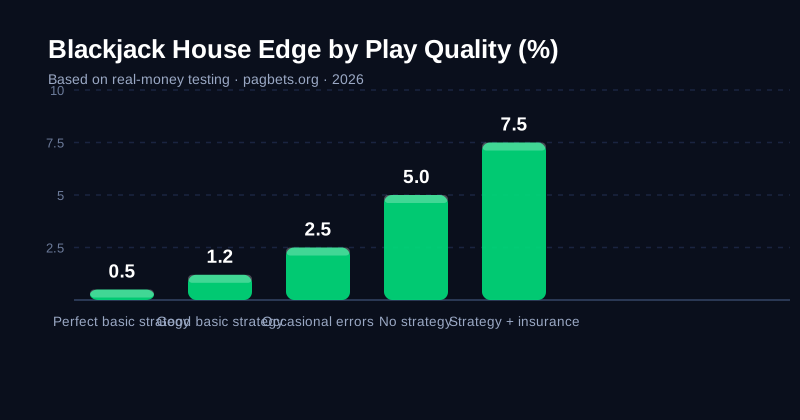
Playing blackjack with no strategy at all produces a house edge of roughly 5%. Playing with perfect basic strategy reduces that to about 0.5% in a six-deck game with a 3:2 payout on blackjack. In other words, following the chart effectively eliminates the house edge and puts you close to even money over a long session.
No other game offers anything comparable. This is why blackjack strategy is genuinely learnable in a way that roulette or slots is not, and it is why our beginner's blackjack guide recommends learning strategy before playing seriously.
How the Decision Chart Works
Basic strategy is a lookup table. The two inputs are your own hand total and the dealer's upcard, and the output is whether to hit, stand, double or split. That is the entire system.
The chart exists because blackjack is a game of dependent probabilities with a small enough number of distinct situations that every one can be calculated in advance. There are 16 possible player totals against a small number of true player hands, 10 dealer upcards, and the correct decision in each case has been known for decades.
There is no reasoning required at the table — that is rather the point. A player following the chart perfectly performs better than one who understands the game intuitively and deviates from the chart when it feels wrong. The chart encodes the mathematics, and intuition is worse at mathematics.
- Hard totals: 8 or below always hit
- Hard 9: hit unless the dealer shows 7, 8, 9 or 10
- Hard 10 or 11: always hit (10 never busts)
- Hard 12: hit against 2 to 6, stand against 7 to Ace
- Hard 13 to 16: stand against 7 to Ace, hit against 2 to 6
- Hard 17 and above: always stand
Soft Hands Deserve Separate Treatment
A soft hand contains an ace counted as 11, which means it cannot bust. A soft 16 and a hard 16 are very different hands, and treating them identically is one of the most common errors in the game.
The rule of thumb is simple: with a soft total, hit until the hand becomes hard, then re-check the chart. A soft 13 through 17 is played by hitting against a dealer 2 to 8 and standing against 7 to 8 and above. A soft 18 is the famous awkward hand — stand against a dealer 2 to 8 in most charts' basic form, and double against 9 through Ace when possible.
Soft 19 and soft 20 are strong hands that should generally be stood on regardless of the upcard. The reason soft hands are worth separating is that they have a higher value than their number suggests, and the chart accounts for that properly.
Reading the Dealer's Upcard
The dealer's upcard is the second input to every decision, and it tells you the dealer's most likely eventual total. A dealer showing 2 through 6 will bust more often than any other upcard, because they must hit on anything below 17, which repeatedly exposes them to busting.
A dealer showing a 7 through Ace is the dangerous case, because they have a strong starting hand and are likely to finish on 17 or better. Against those upcards, standing on a modest total is usually correct, because the dealer rarely busts.
This is why the classic 16 decision reverses so sharply between dealer upcards. Against a 6 you should hit, because the dealer busts often enough to justify it. Against a 10 you should stand, because they will not. Our blackjack guide covers the basic rules before the strategy comes into play.
| Dealer upcard | Dealer bust chance | You should generally | Reasoning |
|---|---|---|---|
| 2–6 | High | Hit weak totals (12–16) | Dealer will bust on the draw |
| 7 | Low | Stand on 12–16 | Dealer likely reaches 17+ |
| 8 | Low | Stand on 12–16 | Dealer likely reaches 17+ |
| 9 | Low | Stand on 10+ | Dealer will rarely bust |
| 10 | Lowest | Stand on 10+ | Dealer almost never busts |
| Ace | Lowest | Stand on 17+ | Dealer is strong and protected |
Rules Variations That Change the Odds
The basic strategy chart is not universal. It is built for a specific set of rules, and several common variations genuinely change the correct decisions and the house edge.
Surrender matters most. Late surrender, allowed on a hard 15 or 16 against a dealer 10, reduces the house edge by roughly 0.45% and adds an option to the chart. Early surrender reduces it further. A table offering surrender is meaningfully better than one that is not, and a chart that ignores the rule is subtly wrong in a handful of hands.
Doubling after split and resplitting aces both help the player, while dealer no-hole card in European blackjack hurts it. The number of decks has a small effect, as does the 3:2 versus 6:5 payout on a natural — and 6:5 pushes the house edge above 2%, which removes nearly all of the advantage that strategy provides.
Before playing anywhere, check the rules table. Our live casino guide covers how these variations appear in practice, and knowing which chart matches your table is a small step that makes a measurable difference to the maths.
Learning the Chart Without Memorising It
Basic strategy is a lookup, not a memory test, and there is no reason to believe the numbers. A chart on a phone, a printed card beside you, or a dealer who will let you consult it are all legitimate tools.
Many casinos permit basic strategy charts at the table, and any that forbid it is unusual enough to be worth avoiding. The strategy requires no equipment and no advantage over the house — it simply avoids the most costly mistakes, which is a matter of protecting your own money rather than gaining an edge.
If you want to internalise it rather than consult it, the realistic path takes around twenty hours of play and is faster in the areas that come up most. The single most valuable block to learn first is the hard 12 to hard 16 range against dealer 2 to 6, because those hands occur constantly and the rule is counterintuitive — hit, even though your instinct says stand.
Track the situations you get wrong as you play. After a session, review which decisions you deviated from the chart on and by how much, and you will find you already know most of it.
Double, Split and Insurance
Doubling is permitted on the first two cards, and basic strategy identifies the specific hands and upcards where it is correct — essentially a hard 9, a hard 10 or 11, and a soft 15 through 18, against the upcards where the extra card is most likely to help. Doubling is how the 0.5% edge is achieved rather than a 0.5% edge being theoretical.Splitting separates a pair into two hands played independently. The most valuable split is always aces, and always against a dealer's 2 to 8 for the same reason as standing — the dealer is more likely to bust. Splitting tens or fives is almost always wrong, and our hand rankings guide covers why a pair of tens is not worth splitting.
Insurance should be declined almost universally. It pays 2 to 1 when the dealer draws blackjack, which occurs about 4.5% of the time, but the true cost works out to a negative expectation of around 7% of the amount insured.