Why Blackjack Is Different From Every Other Casino Game
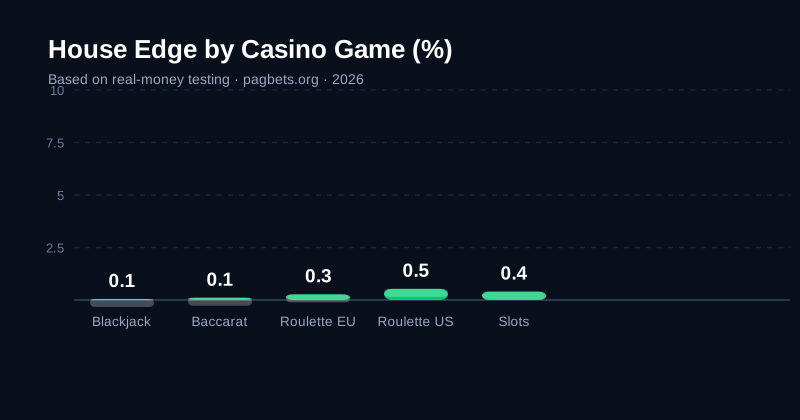
Slots are luck. Roulette is luck. Blackjack is the one casino game where your decisions directly change the result. Play perfectly and the house edge drops to around 0.5% — better than any other game in the casino. Play randomly and the edge balloons to 2–4%. That gap between 0.5% and 4% is entirely your skill, and this guide gives you the tools to close it.
The Rules, Step by Step
You play heads-up against the dealer. Number cards are worth their face value, face cards (J, Q, K) are worth 10, and an ace is worth 1 or 11 — whichever helps more. Both you and the dealer start with two cards; the dealer's second card is face down (the hole card).
You act first. On your turn you can hit (take a card), stand (keep your hand), double down (double the bet, take exactly one card), or split (turn a matching pair into two hands). If your total exceeds 21 you bust and lose immediately. The dealer then plays under fixed rules — usually drawing to 16 and standing on all 17s.
- Blackjack (ace + 10-value card) pays 3:2 on most tables — avoid tables that pay 6:5
- Dealer stands on all 17s (best rule) or hits soft 17 (worse for you)
- Doubling is allowed on any two cards at most tables
- Splitting aces usually gives one card per ace
Hard Hands, Soft Hands and the Strategy Chart
A hard hand has no ace (or an ace counted as 1). A soft hand contains an ace counted as 11 — the beauty of soft hands is they can't bust with one hit, which unlocks aggressive doubling. Basic strategy is a decision table covering every hand against every dealer upcard. The most important lines to memorise first:
| Your hand | Dealer upcard | Correct play |
|---|---|---|
| Hard 8 or lower | Any | Hit |
| Hard 12–16 | 2–6 | Stand (dealer likely to bust) |
| Hard 12–16 | 7–A | Hit |
| Hard 17+ | Any | Stand |
| Soft 13–17 | Any | Hit (can't bust) |
| Soft 18 | 2–6 | Double if allowed, else stand |
| Pair of aces or 8s | Any | Always split |
| Pair of 10s | Any | Never split |
Doubling Down: The Profit Move
Doubling is how basic strategy makes money: when you have the advantage, you double the bet. The classic spots: hard 11 against anything except an ace (you will likely draw a 10), hard 10 against dealer 2–9, and soft 16–18 against dealer 3–6. Doubling correctly adds roughly 1.5% to your expected return — the single biggest strategy gain after standing correctly on hard hands.
Splitting: When Two Hands Beat One
Split aces and eights always — two 8s make a terrible 16, and two aces become two chances at blackjack. Never split 10s or 5s: a pair of 10s is already a near-perfect 20, and a pair of 5s is a 10 that should be doubled, not split. Other pairs follow the chart; when unsure, the conservative default is to split only aces and 8s and treat everything else as its total.
The House Edge, and the Rules That Change It
Standard blackjack with 3:2 payouts, dealer standing on soft 17 and doubling on any two cards carries about a 0.5% house edge with perfect play. Every rule change shifts that number. The worst offender is 6:5 blackjack payouts, which adds 1.4% by itself — a table with 6:5 payouts is roughly four times more expensive than a standard table. Before you sit down, check: blackjack payout, dealer soft-17 rule, doubling restrictions, and number of decks.

| Rule change | Effect on house edge |
|---|---|
| 6:5 blackjack instead of 3:2 | +1.4% (avoid at all costs) |
| Dealer hits soft 17 | +0.2% |
| No doubling after split | +0.15% |
| Single deck (vs 8 decks) | -0.5% (better for player) |
| Late surrender allowed | -0.07% (better for player) |
Online Blackjack: RNG vs Live Dealer
Online blackjack comes in two forms. RNG tables are software-shuffled, fast, and available from $0.10 stakes — ideal for practising basic strategy at speed. Live dealer tables stream a real dealer from a studio, dealing real cards at a real pace; they're the authentic experience and the right place to play once the chart is memorised. At Stake and 22Bet we've verified both variants running fairly with clear rules displayed.
Practice first: most casinos offer free-play blackjack, and a few hours at zero cost will burn the chart into muscle memory faster than any article.
Bankroll Rules for Blackjack
Blackjack variance is lower than slots but real: expect swings of 20–40 bets in a session. Flat-bet 1–2% of your bankroll per hand, never chase a losing streak with bigger bets, and leave the table after doubling your session budget either way. Our bankroll guide covers the full system.
Card Counting: The Truth
Card counting is legal, mathematically real, and effectively dead online. RNG tables reshuffle every hand, and live dealer tables cut the shoe so deeply that the counting edge mostly disappears. If you want to count, you'd need a land casino, a team, and a tolerance for being asked to leave. For everyone else, perfect basic strategy is the honest edge — and it's plenty.
Start Playing Blackjack the Right Way
The path is simple: memorise the eight-line table above, practise free-play until it's automatic, choose a 3:2 table with good rules at a licensed casino from our casino reviews, and flat-bet within your bankroll. Blackjack rewards exactly this kind of process — and punishes exactly the opposite.