
The One Number That Explains Slots
Every slot machine has a return-to-player percentage — RTP — and it is the most misunderstood number in the casino. RTP is the share of all wagers a game returns over its lifetime: a 96% slot pays back $96 for every $100 wagered, across millions of spins. It is not what you'll get back tonight; variance guarantees your session will differ wildly. But over time, RTP is destiny — and choosing between a 94% slot and a 98% slot is choosing between losing $6 or $2 per $100 wagered. That's the entire edge available to slot players, and it's worth taking.
RTP vs Volatility: The Two Axes of Every Slot
RTP sets the long-run cost; volatility sets the shape of the ride. A low-volatility slot pays small wins constantly — sessions feel steady and last long. A high-volatility slot starves you for spins, then pays a lump — sessions swing dramatically. Both can carry identical RTP. The practical rule: pick low volatility for entertainment on a small budget, and only touch high volatility with money you accept may vanish quickly in pursuit of a rare big win.

| Volatility | Win pattern | Best for |
|---|---|---|
| Low | Frequent small wins | Long sessions, small budgets |
| Medium | Balanced | Most players |
| High | Rare big wins | Jackpot hunters with discipline |
The High-RTP Slots Worth Knowing
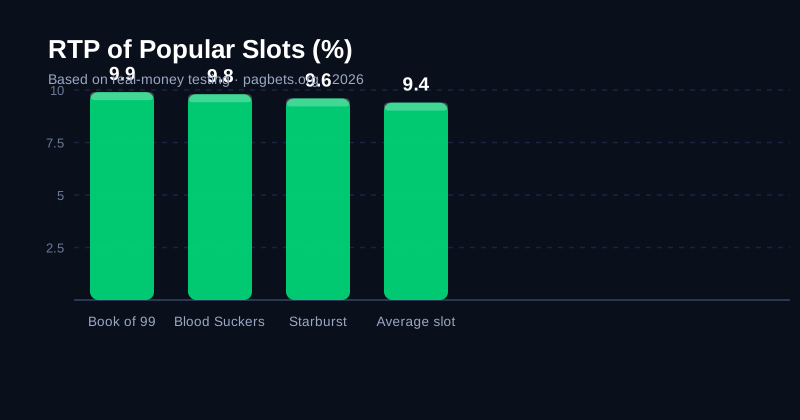
RTP varies by game and even by casino version of the same game. The famous outliers: Blood Suckers (98%), Book of 99 (99%), Mega Joker (up to 99% at max bet), and 1429 Uncharted Seas (98.6%). Mainstream hits cluster at 96–96.5%. A four-point RTP gap is the difference between losing $4 and $8 per $100 wagered in expectation — no skill required to capture it, just selection.
Why 'Hot' and 'Cold' Machines Are a Myth
Every legitimate slot uses a random number generator: each spin is independent, and the machine has no memory of the last thousand. A slot that just paid a jackpot is no more or less likely to pay again than one that hasn't paid for an hour. The belief otherwise — the gambler's fallacy — is how casinos make most of their money. RTP emerges statistically; it never obliges a specific session.
Smart Slot Play: The Four Rules
Slots are negative-expectation entertainment, and the intelligent version of playing them comes down to four rules:
- 1. Check RTP before every session — and pick games at 96.5% or above where available
- 2. Match volatility to your budget — low variance for longevity, high variance only with discipline
- 3. Flat stakes — a fixed spin size, usually the minimum, keeps sessions long and costs predictable
- 4. Session limits — a pre-set loss and win ceiling per session, because slots are designed to make you forget the clock
Slots and Bonuses: Where the Real Edge Lives
The only way to play slots at positive expectation is through bonuses — free spins and deposit matches where the wagering maths works in your favour. Most bonus wagering requires slot play, and a 30x bonus-only requirement on a 96% RTP slot costs roughly the bonus itself in expectation, making the bonus roughly break-even to slightly positive. Our bonus maths guide teaches the full calculation.