
RTP and Volatility Are the Only Two Things That Matter
A slot's theme, artwork, soundtrack and bonus features are irrelevant to its mathematics. Two numbers determine the shape of any session: the return to player percentage and the volatility.
RTP is the average proportion of money wagered that the game returns over a very large number of spins. A 96% RTP means that for every 100 units wagered, 96 come back over time. It is a long-run average across millions of spins, not a prediction about your session, which is why individual sessions vary so widely from it.
Volatility describes how far individual results sit from that average. A low volatility slot sits close to its mean, so results arrive steadily in small amounts. A high volatility slot swings far from the mean, so you get long stretches of nothing punctuated by occasional large wins. Neither is better. They are suited to different bankrolls and different temperaments, and our full RTP guide covers the maths in more depth.
Choosing by Bankroll and Session Length
Match the volatility to how long you intend to play. A low volatility slot with a 96% RTP will return small amounts steadily and give you a long session, with a low risk of losing everything quickly. A high volatility slot at 96% will return much less frequently, with a real chance of a large early win and a real chance of exhausting your balance in a fraction of the time.
The common mistake is choosing high volatility because the top prize looks larger. A 5,000x maximum win is not going to arrive on a budget that allows a meaningful number of spins, because the frequency of triggering it is far too low. The maximum win figure is only meaningful relative to a bankroll large enough to survive until it could occur, which for most advertised figures means never.
For a beginner session, a low volatility slot with a solid RTP and a modest maximum bet is the sensible combination. It produces more entertainment per unit staked, because you are not watching a balance drain through a long dry stretch.
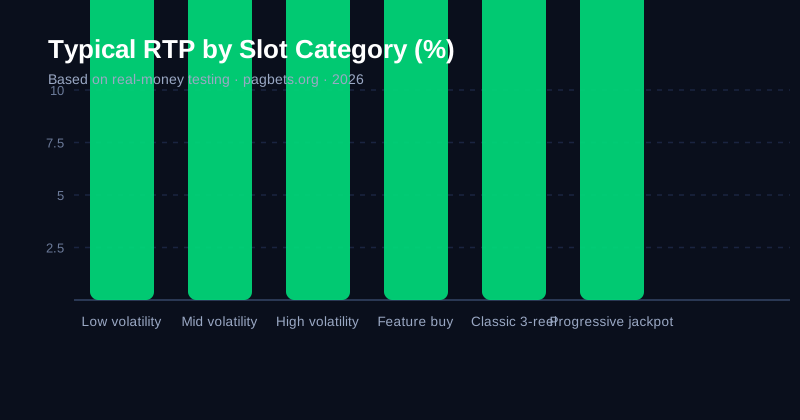
| Slot type | RTP | Volatility | Session profile | Best for |
|---|---|---|---|---|
| Classic, 3-reel | 92–95% | Low | Long, steady | Relaxed play |
| Modern video slot | 94–96% | Low to medium | Medium length | Most players |
| Feature buy slots | 94–96% | Medium to high | Short, punchy | Those wanting speed |
| High volatility | 94–97% | High | Short, volatile | Larger bankrolls only |
| Progressive jackpot | 90–95% | High | Long, rarely pays | Entertainment only |
Reading the Max Win Figure Critically
Maximum win numbers are the most heavily promoted figure in online slots, and they are also the least useful. There are three things to check before taking one seriously.
First, is the cap per spin or total? Many games cap the maximum win across all spins rather than allowing it in one win, which changes its meaning entirely. Second, what triggers it? A 250,000x figure requiring a specific five-symbol combination on one payline out of twenty is not comparable to a 5,000x figure reached in a bonus round. Third, at what bet level? Some games scale the maximum with stake and others do not, and a game that only pays a huge maximum when betting the absolute maximum is not a game most people are playing.
The honest position is that maximum win figures are designed to be impressive rather than informative. Judge a game on its RTP and volatility, and treat the rest as theme.
Feature Buy and What It Really Changes
The feature buy or bonus buy option on many modern slots lets you pay a fixed amount to trigger the bonus round directly, skipping the wait for scatters. It is genuinely convenient and it does change the maths in one important way: the cost of the feature is included in your wager, so the effective RTP on that portion is the same as the base game.
What it does not do is improve the return. A feature buy simply pays for access to the bonus sooner. Some players prefer it because it makes the session predictable in structure, but it also concentrates your entire stake into a single high-variance event, which is the opposite of what a low volatility slot normally does.
Our slot paytable guide covers how to read the rules for any specific game, including exactly what each bonus feature does and how often it triggers.
Why Session Length Matters More Than RTP
A 97% RTP slot played for ten minutes and a 92% RTP slot played for ten minutes will produce results that differ far less than the percentages suggest. In a short session, variance dominates completely, and the RTP is a description of a process rather than a prediction about what will happen to you.
This is worth internalising because it explains why a difference in advertised RTP matters far less than most players assume. Going from 92% to 97% changes the expected loss on 100 units of wagering from 8 units to 3 units. Over a two-hour session at average stakes, that is a real difference — but over ten minutes, the results are essentially random for both games.
The practical consequence is that a short session should be treated as entertainment with a budget, not as an attempt to exploit a favourable return. If your goal is to make RTP meaningful, you need enough spins for the average to start behaving, which means both a longer session and a smaller average stake.
There is a useful comparison here with the bonus maths. Wagering requirements are measured in volume, not time, and a player using a bonus needs volume rather than a quick session. Our bonus terms checklist covers how the two interact.
RTP in Practice: What a Session Actually Returns
It is worth putting a real number on what a percentage means, because the abstraction is where most confusion lies.
At 96% RTP, wagering 1,000 units returns 960 over time. That is a loss of 40 units, spread across however many spins took. But an individual session wagering 100 units will return anywhere from almost nothing to considerably more than 100, because the variance around a 96% average is very wide.
Two honest observations follow. First, no single session demonstrates a game's RTP, and a player who judges a slot by one session is measuring luck. Second, the difference between games is real but gradual — a 92% game costs roughly 8% of turnover and a 97% game costs 3%, so a hundred units wagered costs 8 against 3. Over a heavy session that matters; over a brief one it is largely invisible.
What does not vary is that every one of those numbers is negative. The slot is not a game where the RTP is waiting to be unlocked by playing well. Our house edge guide covers the underlying mathematics.
Casino Bonuses and Slot Choice
If you play with bonus funds, the slot you choose matters considerably more than usual, because the game weighting determines how much of each bet counts toward the wagering requirement. Slots typically count at 100%, table games at 50 to 80% and live dealer games sometimes as low as 10%.
There is a further trap in maximum bet caps. Almost every bonus includes a cap on the largest single wager, and bets above it frequently contribute only the stake to the requirement and not the winnings. On a high volatility slot, a single oversized bet can exceed the cap by accident and turn a large win into lost progress.
Check both the weighting table and the maximum bet cap before choosing a slot with bonus money. Our bonus terms checklist works through the calculations, and our best slots comparison ranks titles on the measures that matter.
- Check the RTP first, 96% or better
- Choose volatility to match session length, low for longer
- Read the paytable before depositing, not after
- Treat max win figures as advertising, not as a return
- Check game weighting and bet caps when using a bonus
- Never chase a progressive, the maths does not change
- Set limits with our responsible betting tools guide before a session