
Why Most Football Systems Fail (And These Don't)
Football is the most efficient betting market in the world — sharp syndicates, billion-dollar volumes, margins near 4%. Any system promising certainty is lying. What survives in this environment is a process: data-driven, specialised, and disciplined. The seven strategies below are the ones that still hold up in our 2026 testing — not because they're clever, but because they exploit specific, repeatable market behaviours.
Strategy 1: Expected Goals (xG) Regression
Expected goals is the single most powerful public tool in football betting. Teams that score far above their xG are riding variance, and the market — influenced by recent results — prices them too short. Teams creating good chances but missing them are priced too long. The strategy: identify teams whose results diverge from their xG over the last 6–8 matches, and bet against the market's overreaction — backing underperforming teams on the Asian handicap, and opposing overperforming ones.
| Signal | Market reaction | Your play |
|---|---|---|
| 5 goals from 8.0 xG (overperforming) | Odds shorten | Oppose or avoid backing |
| 3 goals from 7.5 xG (underperforming) | Odds lengthen | Back on Asian handicap |
| xG stable, results volatile | Overreaction | Value on the regression side |
Strategy 2: Asian Handicap Specialisation
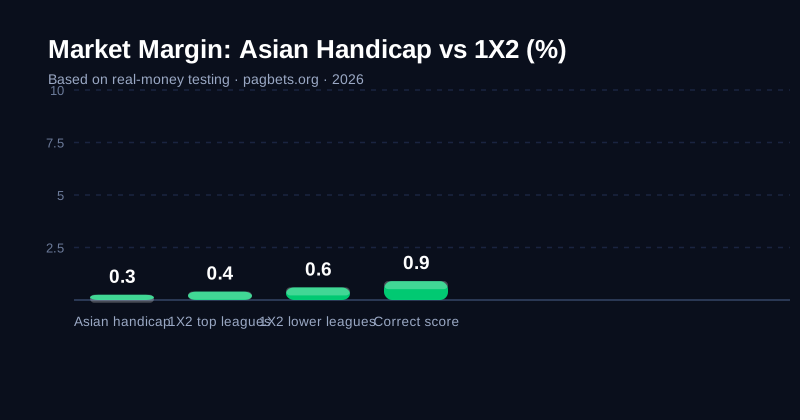
Asian handicaps strip the draw out of the equation and carry margins of 2–3% — roughly half the 1X2 margin. In matches where one side is clearly stronger, a -0.75 or -1.0 line often prices the favourite's dominance more honestly than the 1X2 does. Specialising in Asian handicap betting on one league, at one bookmaker with sharp lines (Bet365 is our reference), is the fastest route to systematically lower margins.
- Use -0.25/-0.75 split lines to halve risk on uncertain favourites
- Target home underdogs +0.5 in leagues with strong home bias
- Avoid handicap betting in derbies and relegation six-pointers — motivation breaks models
- Compare the line across two bookmakers before every bet
Strategy 3: Form vs Class
The market overweights recent results (form) and underweights underlying quality (class). A strong team on a poor run of fixtures is frequently priced below its true level — particularly early in the season, when small samples distort perception. The strategy is contrarian but simple: buy class at a discount. The discipline is equally simple: class is proven over seasons, so this strategy only applies to teams with a genuine multi-year record.
Strategy 4: The Draw Specialisation
Draws are the least popular bet in football — and the least efficiently priced. In leagues with high draw rates (many South American and lower European divisions exceed 30%), specific matchups produce draw probabilities the market underprices: mid-table clashes between defensively solid, goal-shy sides. Betting draws flat at 2% stakes in these spots is boring and, over a season, consistently profitable — precisely because nobody else wants to do it.
Strategy 5: Live Betting the Momentum Gap
In-play prices move with the scoreline faster than with the game. The edge: watch the match and bet between events when the price lags reality — a team dominating without scoring sees its price drift outward, while its live xG says the goal is coming. Bet next-goal and match-result markets in these windows, never during active attacks, and stop after two live bets per match. Our live betting guide covers the mechanics fully.
Strategy 6: League Specialisation
One league, followed deeply, beats ten leagues followed shallowly — every time. Specialisation compounds: you learn the tactical styles, the referee tendencies, the travel fatigue patterns, the manager changes. Within two seasons, your league-specific estimates genuinely beat the market's generic models. Choose a league with data you can access (xG is published for most top divisions) and matches you can actually watch.

Strategy 7: The Discipline Layer
No strategy survives without the discipline layer: flat stakes at 1–2% of bankroll, a maximum of 5–10 bets per weekend, no betting on teams you support, no chasing, and a full log of every bet with its odds and reasoning. Quarterly, compare your prices against the closing line. The strategies above are engines; this layer is the fuel. See our bankroll guide for the complete system.