Betting's Oldest Market, Demystified
Horse racing invented organised betting, and its vocabulary still intimidates newcomers: each-way, place terms, handicaps, the going. Strip the jargon away and racing is simply the most form-rich sport in betting — every runner has a public, documented history, and the market moves on information that a diligent bettor can read. This guide covers the bet types first, then the form-reading basics that turn racing from a lottery into a research exercise.

Win, Place and Each-Way: The Three Bets That Matter
Win needs no explanation — the horse must finish first. Place pays if the horse finishes in the top positions (2nd, 3rd, sometimes 4th depending on field size), at a fraction of the win odds. Each-way combines both: one stake split into a win bet and a place bet. An each-way $10 is really $5 on the win at full odds and $5 on the place at the stated fraction — two separate settlements.
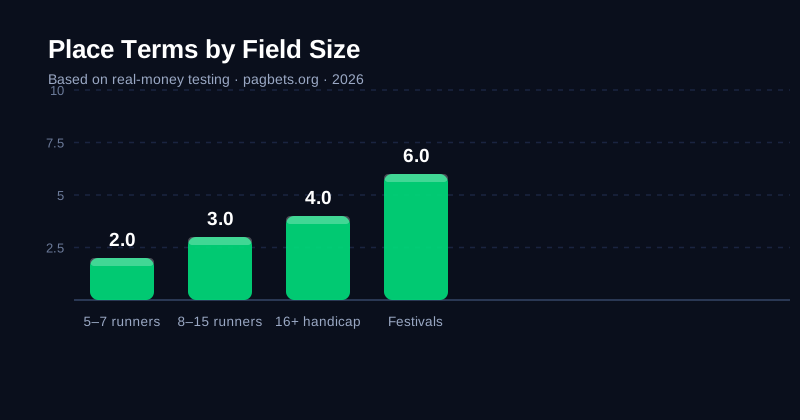
| Field size | Typical places paid | Place fraction |
|---|---|---|
| 5–7 runners | 2 places | 1/4 odds |
| 8–15 runners | 3 places | 1/5 odds |
| 16+ runners (handicaps) | 4 places | 1/4 odds |
| Major festivals | Up to 6 places | Varies — check terms |
When Each-Way Makes Mathematical Sense
Each-way betting is the smart bet when the place part carries value on its own — typically on horses priced between 8/1 and 20/1 in large fields, where a top-four finish is genuinely likely and the place fraction still pays profit. It's a poor bet on short-priced favourites (the place part pays pennies) and on 100/1 outsiders (neither part is likely). The rule of thumb: bet each-way when you'd happily back the horse to place at the offered terms; otherwise bet win only.
Reading Form: The Four Basics
Form reading starts with four questions. Recent form: what did the horse do in its last three runs — and were those races at the right level? The going: soft-ground specialists underperform on firm turf and vice versa; this single factor moves results more than any other. Distance: does the horse's best form come at today's trip? The human team: jockey and trainer strike rates, particularly in combination, are public and predictive. Answer all four before looking at a price.
- Recent form: last three runs, at a similar class level
- Going: ground conditions and the horse's record on them
- Distance: proven stamina or speed at today's trip
- Team: jockey and trainer strike rates, especially combined
Handicaps: The Value Hunter's Ground
Handicap races assign weights by official rating to equalise the field — and equalised fields produce the market's least efficient prices. The value pattern to look for: a horse whose recent form shows improvement beyond its handicap mark (often a lightly raced type or one returning to a preferred surface). The market prices the rating; you price the trajectory. That gap is where racing's best long-term value lives, which is why serious racing bettors concentrate on handicaps.

Market Moves: Morning Line to the Off
Racing markets move on information: paddock appearance, betting volume, weather changes. A horse that shortens steadily through the day is being backed by informed money; a drifter is being avoided. Neither is a bet signal by itself — but combined with your form reading, market movement is a useful check. If your form analysis says one thing and the market strongly says another, find out why before betting. Best-odds-guaranteed bookmakers (Bet365 offers it on UK/Irish racing) remove the fear of drift on early prices.
Discipline for a Daily Sport
Racing runs every day somewhere in the world, which makes volume the biggest discipline risk. The professionals' rhythm: select a few races per week, not every card; flat-bet 1–2% of bankroll; keep a separate racing bankroll if you also bet other sports; and log every bet with the going and distance noted — the patterns in your own results are the fastest teacher. Our bankroll guide applies unchanged.