
The Format Shapes Everything
Darts is played in legs, where each player throws three darts and the higher score wins the leg. A match is a set number of legs — first to 11 in a standard match, first to 21 in the major televised tournaments. Almost every market in darts is built out of these two units.
That structure creates something unusual: a large number of genuine decision points in a short space of time. A best-of-21 match might feature twenty legs, each lasting three to five minutes, and a single leg contains several meaningful decision points as a player approaches a finish. For a bettor, that is an unusually dense sequence of situations — and unusually dense sequences invite impulse.
It also means darts markets are among the most efficient in sport betting. A televised match attracts substantial money, and most of it arrives before the first dart is thrown. Our value betting guide explains why efficiency makes finding edges harder.

Order of Play and Why It Alters the Numbers
In standard darts rules, the player who throws first throws first in every leg, and the other player throws first in alternate legs. Throwing first is a real advantage: you choose your target score and your opponent must chase it, which means your opponent is frequently under pressure on a low checkout.
Over a long match this accumulates. A first-throw advantage that is worth 0.3 points per leg across twenty legs is worth far more than the same edge across three legs in a short format. It is why a player whose statistics look excellent overall can perform worse than expected in a best-of-21 if the draw has given them the first throw more often than not.
Several bookmakers offer a handicap market precisely because of this. A player who throws first throughout can be given a leg or two against a stronger opponent, and the handicap price should reflect the average advantage. Our handicap betting guide covers the settlement mechanics.
- Match winner: who wins the whole match, usually best of 21 in majors
- Set/leg line: total legs, or the winner's leg count
- Handicap: legs given or taken between players
- Highest checkout: the biggest finish a player completes
- Most 180s: how many maximum three-dart scores in a match
- First 180: who hits the first maximum score
Checkout Prices and the Live Opportunity
The most interesting live darts market is the checkout — betting on whether a player will finish a specific number, usually expressed as a score range such as 100 or more, 140 or more, or a named checkout like 170.
As a player approaches a finish, the price moves sharply, because the probability of completing it is a known function of the score remaining. A player on 170 has a specific double — the triple twenty then the bull — and the chance of taking it first attempt is about 25%. A player on 32 has a much better chance, and the live price should reflect that accurately.
The opportunity appears when a bookmaker's live price lags the situation, which is most likely on a bigger checkout where the exact combination is less common. The risk is symmetrical: the same lag works against you when a player is on a routine double and the price is still wide. Our in-play betting risk guide covers the discipline this requires.

Researching a Darts Tournament Properly
Darts form data is unusually rich, and it rewards a structured approach more than most sports.
Three-dart average is the central metric, and it is stable enough to project from. A player averaging 105 is a fundamentally different proposition from one averaging 88, and the difference is worth more than any single result. Checkout percentage is the second most important: the ability to finish a routine double separates professionals from good club players more reliably than scoring alone.
Beyond those, look at legs won on doubles, which measures finishing under pressure, and tournament pedigree — a player who has reached a televised major final has demonstrated an ability to perform under real pressure. Finally, check average checkout and 180 frequency, which are directly market-relevant because the props are priced from them.
| Metric | What it measures | Why it matters | Typical good value |
|---|---|---|---|
| Three-dart average | Scoring consistency | Best single predictor of overall strength | 100+ |
| Checkout percentage | Finishing routine doubles | Separates pros from good amateurs | 40%+ |
| Legs won on doubles | Pressure performance | Indicates nerve under pressure | 10+ |
| 180 frequency | Maximum-score rate | Directly drives the 180 props | 3%+ of visits |
| Average checkout | Size of finishes taken | Drives highest-checkout markets | 45+ |
Where Value Sits in Darts
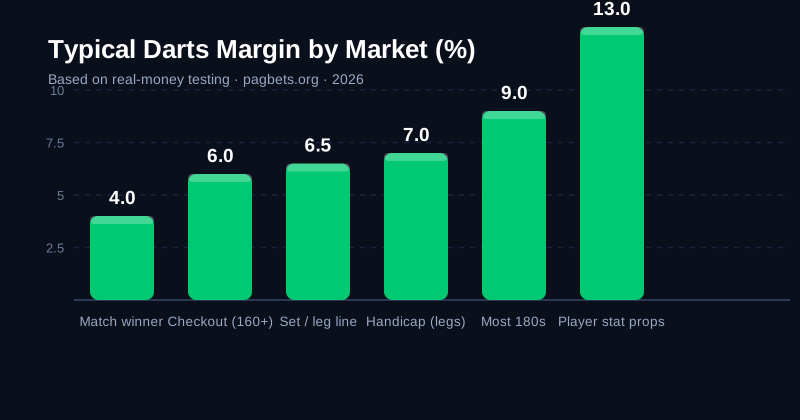
Match winner is the most heavily bet and the most efficient, so it is generally the hardest market to beat. The better opportunities are usually elsewhere.
Set and leg lines offer value more often, partly because the line has to be set from a total-legs estimate and partly because a first-throw advantage is often under-weighted. Checkout props are priced from a genuine probability calculation, which means genuine mistakes are possible and genuine value exists.
What is usually best avoided is anything framed around a specific narrative — a player's comeback, a tournament storyline, a 'too good to go on' selection. Those attract concentrated money precisely because they are easy to explain, and the margin is correspondingly wide. Our roulette odds guide covers the same principle in a different game.
How Darts Data Is Collected and What It Tells You
Dars data is unusually rich, and the way it is collected matters for how much weight to place on it.
Three-dart average is calculated across a rolling window, most commonly the last 12 or so matches, and a longer window gives a more stable but less current figure. The best practice is to look at both — a player averaging 108 over twelve matches and 98 over three is in decline, and the shorter figure is more relevant to the next match.
Checkout percentage is the metric that most separates professionals from strong amateurs, and it is the one most casual punters ignore. A player averaging 100 but checking out only 32% of the time is a dangerous bet at any price, because the same scoring rate produces fewer wins than the average suggests. Data providers also distinguish legs won on doubles, which measures performance under direct pressure from an opponent.
Finally, tournament pedigree carries genuine information. Players who have reached televised major finals have demonstrated an ability to perform when stakes and pressure are highest, and that is a quality that averages do not capture.
A Disciplined Approach
Darts is a game of fine margins, and the main risk is that the density of legs makes over-betting almost effortless. A televised session might offer 120 legs, and betting on most of them is a losing proposition simply on margin.
A workable routine is to research the tournament once, identify the two or three markets you understand best, and bet a small flat stake on those. Do not bet on every leg. Do not chase. Record everything, and review after a tournament rather than after each session.
The most common error in darts is treating a familiar name as a reason to bet. Knowing a player's average matters; recognising them from television does not. Set firm limits with our responsible betting tools guide, and if the betting stops feeling like entertainment, our responsible gambling page lists professional support options.
- Research the tournament once, not every leg
- Bet on a few markets only, ignore the rest
- Use three-dart average and checkout % as your core metrics
- Flat stake, never increase after losses
- Leave the narrative markets alone, the margin is wide
- Record every bet, review per tournament
- Set limits with our responsible betting tools before the session