
Leveling the Field
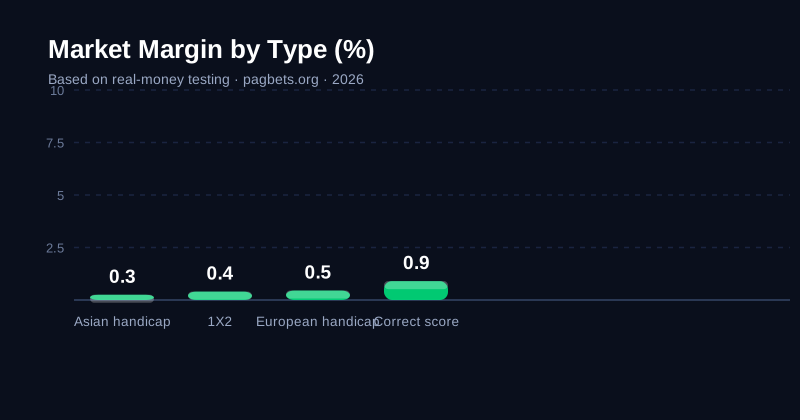
When Manchester City plays a relegation side at 1.15, the 1X2 market offers nothing to think about — and nothing to earn. Handicap betting solves both problems by levelling the game: the favourite gives goals or points (a minus line), the underdog receives them (a plus line), and the bet settles on the adjusted result. The deeper benefit is structural: Asian handicaps carry margins of 2–3%, roughly half the 1X2 cost — the cheapest football market available.
The Line Systems: Asian vs European
Two systems coexist, and knowing which is which matters. European handicaps use whole numbers with three outcomes — a -1 handicap means the favourite must win by 2+, and a one-goal win loses (the draw on the adjusted score is a live outcome). Asian handicaps use halves and quarters, remove the draw entirely, and add two refinements: whole lines that push (refund) when the adjusted result is exact, and quarter lines that split your stake across two adjacent lines. The removal of the draw is why Asian margins are lower.

| Line | Favourite wins by | Settlement |
|---|---|---|
| -0.5 | Any margin | Win |
| -1.0 | 2+ | Win |
| -1.0 | Exactly 1 | Stake refunded (push) |
| -1.25 | 2+ | Win (both halves) |
| -1.25 | Exactly 1 | Half win, half refund |
The Quarter-Line Maths, Step by Step
Quarter lines intimidate newcomers, and the maths is simpler than it looks: -0.75 splits your stake 50/50 between -0.5 and -1.0. Win by one goal: the -0.5 half wins, the -1.0 half refunds — you profit on half your stake. Win by two: both halves win. Draw: both halves lose. Once you read every quarter line as two adjacent halves, the entire Asian handicap board becomes legible.
When Handicaps Beat 1X2
Three situations favour handicaps. Short favourites: when 1.15 offers no value, -1.5 or -1.0 on the same team pays 1.80–2.20 for a bet your analysis actually supports. Resilient underdogs: a defensive side you expect to lose narrowly is +1.5 or +1.0 territory — backing them to cover extracts value from a loss. Accumulator bonuses: most welcome offers at 1xBet and Melbet require accumulator legs, and Asian handicap legs carry the lowest margins to clear them with — see our acca guide.
Handicap Strategy: The Two Questions
Every handicap bet reduces to two questions. First: how much will the favourite win by? Your answer comes from expected goals and matchup analysis, not from the 1X2 price. Second: which line converts that margin into the best price? The answer comes from comparing the handicap ladder at two bookmakers — the same view of the game can be +1.5 at 1.85 or +1.0 at 2.10, and the difference is real money. Our odds guide teaches the price comparison habit.
Getting Started
Pick one league, track expected goal margins for two weeks, and paper-trade Asian handicap lines before staking. Open accounts at two bookmakers from our rankings, compare the ladder on every bet, and flat-bet within your bankroll rules. Handicaps reward exactly this process — they're the market built for bettors who do the margin maths.
Asian and European Handicap Are Different Products
The two handicaps are frequently described interchangeably and they are not the same bet.
An Asian handicap settles on a half or whole line, so there is a genuine push possibility: a whole-line handicap that lands level returns the stake. A European handicap covers only win or lose, always includes a push on a level result, and costs more as a result. The price difference between them is not the bookmaker's margin; it is the price of removing the push. Our the Asian handicap guide covers the settlement rules in full.
Our draw no bet is the two-way European structure, and the difference between the three explains most of the pricing confusion between them.
Why a Handicap Move Is Not the Same as a Price Move
A team covering more of the handicap than the market expects is a market error; a team shortening in the outright price is usually not.
The handicap is where the line-setter's model and the market's model disagree about the margin of victory, and that disagreement is exploitable. The outright price moving usually reflects money arriving rather than new information, and a bettor chasing price movement has usually chased it late. Our the margin guide covers why the handicap is the sharper market to work in.
Goal Handicap, Corner Handicap and Half-Time Markets
The standard handicap market settles on the final score, and there are three variants that settle on something else. Goal handicap (also called team total or Asian handicap on goals) is a line on one team's own scoring rather than the match result: a line of under 1.5 on a team means they score zero or one. Corner handicap does the same on corners, and half-time handicap applies the same minus or plus line to the score at the interval rather than at full time.
Goal handicaps are the most useful of the three and the most misunderstood. A team total of over 1.5 at 1.80 is not a prediction that they will win; it is a claim about scoring distribution, and it can win in a 2-0 defeat just as easily as a 3-1 win. That makes it a genuinely different bet from the match handicap, and a research-based total bettor can be right where a result bettor is wrong.
Half-time handicaps carry higher margins and much higher variance, because 45 minutes of football produces far fewer events than 90. A team 0.5 goals up at half time in roughly half of all matches does not mean the market is efficient — it means the sample size per match is small, so the price is wide and often stale. Our live betting guide covers when the half-time line is better traded in-play instead.
Corners are the worst-priced of the three and should be treated as entertainment. Corner counts are driven by goal-line effects and pre-match game states rather than by team strength, correlation between corners is high, and margins sit above 8% at most books. Bet them at under 1% or not at all.
Using a Model to Choose the Line, Not the Side
The typical handicap bettor picks a side and then hunts for a line. Reversing that order produces better results. Build the expected margin first, then read down the ladder and take the line whose implied probability your model disagrees with most. The line, not the team, is where most of the value sits.
Start with expected goals for both sides, adjusted for venue and absences, and take the difference. A side with 1.85 expected goals against 1.10 has an expected margin of 0.75, which sits between -0.5 and -1.0. That is the region to look at: if the book offers -0.5 at 1.55 and -0.75 at 1.85, your 0.75 margin is fairly priced at the quarter line.
Now do the conversion, because it is the step people skip. Decimal 1.85 implies 54.1%, but at a typical 4% margin the true probability is nearer 50%. Converting everything to margin-free implied probability before comparing is what makes the ladder readable, and it changes which line you would take more often than any research upgrade will.
Then set the threshold. Requiring your estimate to differ from the market's by at least three percentage points after margin removal keeps you out of the marginal bets, and the sportsbook margin guide has the arithmetic. Measure the results in closing line value before you trust the model.
How to Buy the Handicap at the Right Price
A handicap bet is priced as a ladder, and the shape of the ladder is where the money is. Because the margin is distributed across the whole board rather than loaded onto one line, the popular lines are slightly worse than the unpopular ones. A -1.5 line attracts most of the money, so it carries more margin than a -1.25 sitting next to it.
The practical routine is to compare the ladder across two or three books rather than the single price at your usual book. Our correct score guide makes the same point on a higher-margin market, but on handicaps the differences are small enough to be worth the effort: a quarter-line difference is a real edge, ten cents of price on the same line usually is not.
The exchange is the best cross-check. Because exchange prices carry commission rather than a built-in margin, the exchange mid-price for the line is close to the true market opinion, and any book offering a materially better price than the exchange mid is offering you value. Our exchange guide covers reading that market and taking the price.
Finally, be honest about which handicap bets to skip entirely. Derby matches, six-pointers with nothing at stake, and cup ties where one side will protect a lead produce outcomes driven by motivation rather than by the margin your model projects. Motivation is not modellable, so it is not bettable at these margins. Our in-play risk guide covers trading them once the game is under way instead.
✓ What We Like
- Covers the payment problem that decides whether the product is usable for you
- Explains the tax structure, which is the part that sets the price
- Uses named regulators, laws and figures rather than general description
✕ What Could Improve
- Several rules are being tightened, so a figure written today may not hold


