
The Game That Made Multipliers a Spectator Sport
Crash games took one idea — a rising multiplier that can end at any moment — and turned it into the most-watched casino product in the world. Aviator, Crash, Mines, Plinko, Limbo: they all share the same DNA. A value climbs, players decide when to leave, and one instant of hesitation turns a win into a loss. That instant is the entire game, and understanding its maths is the difference between entertainment and a slow bleed.
This guide explains how crash games actually work, what the multipliers really mean, and the cash-out discipline that keeps them enjoyable.

How Each Crash Variant Works
Four formats dominate the category. Aviator (Spribe): a plane climbs with a rising multiplier; cash out before it flies away. Crash (Stake Originals): the same curve, no theme, provably fair. Mines: reveal tiles on a grid; each safe tile raises your multiplier, and hitting a mine ends the round. Plinko: drop a ball down a peg board; where it lands determines the multiplier, with risk levels you choose in advance. Each has its own rhythm, but the core decision is identical: cash out before the ending arrives.
| Game | Mechanic | House edge | Verifiable? |
|---|---|---|---|
| Aviator | Climbing multiplier | ~3% | Yes (Spribe) |
| Crash | Climbing multiplier | 1% | Yes (provably fair) |
| Mines | Grid reveals | 1% | Yes (provably fair) |
| Plinko | Peg board drops | 1%–3% | Yes (provably fair) |
The Maths Behind the Multiplier
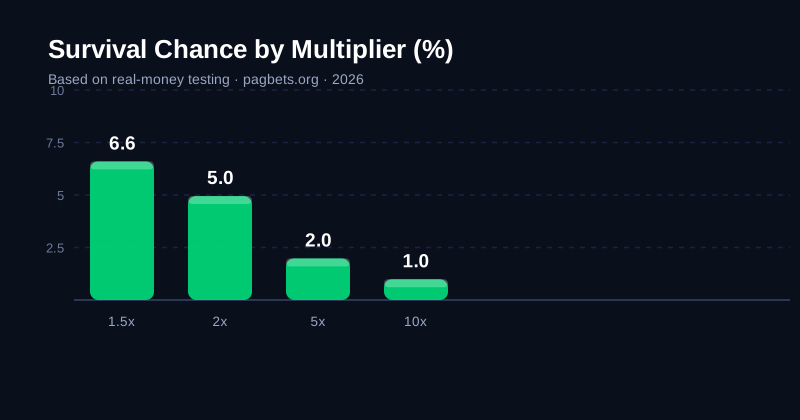
Every crash game is built on one statistical fact: the chance of the multiplier reaching any level falls as the target rises. In a 1%-edge game, the probability of reaching 2.00x is roughly 49.5%, reaching 5x roughly 19.8%, and reaching 10x roughly 9.9%. That means a 2x auto cash-out wins about half the rounds, and a 10x target wins roughly one in ten.
Multipliers are not a ladder to climb — they're a price for risk. Chasing 50x with flat stakes means watching dozens of rounds end in a crash, and the variance destroys bankrolls far more often than the edge alone would suggest. Our house edge guide explains why the long-run maths always wins.

Auto Cash-Out: The Only Real Strategy
Crash games are designed to reward reflex and punish hesitation — which means the most valuable tool in the product is the auto cash-out button. Setting it removes emotion from the most emotional decision in gambling. Three proven configurations:
- Low volatility: auto cash-out at 1.5x–2x, flat stakes — frequent small wins, long sessions, and high survival
- Balanced: auto cash-out at 3x–5x, flat stakes, accept longer dry spells between wins
- High risk: 10x+ targets with minimum stakes only — treat as lottery tickets with a fixed monthly budget
Bankroll Rules for Multiplier Games
Crash games have the highest variance in the casino, which makes bankroll discipline the entire difference between players who last and players who don't. The rules that work are unglamorous: stakes of 0.5–1% of bankroll (half the standard table-game stake), a hard session loss limit, a fixed number of rounds per session, and an absolute rule against increasing stakes after a crash. Our bankroll guide explains the staking maths; crash games simply require the strictest version of it.
Where to Play Crash Games Safely
Provable fairness is the crash player's best protection: choose a licensed operator that publishes seeds and offers a verifier. Stake (Crash, Dice, Plinko, Mines) is our reference, and Mostbet is the most popular Aviator destination in South Asia. Check the licence, verify one round yourself, and set your auto cash-out before the first spin. See our crypto guide for the provably fair verification steps.