The Single Most Useful Distinction
Every casino game divides into one of two categories, and knowing which is which answers most of the questions people ask about them.
In a game of chance, the outcome is determined by an independent random event and no decision you make affects it. Roulette, baccarat, lotteries and the wheel portion of a slot are all in this category. Strategy cannot change the expected return, and any system claiming otherwise is mistaken.
In a game of skill, your decisions materially affect the outcome. Blackjack, video poker and craps are here, because a correct decision changes the result of a hand. Skill reduces the house edge, sometimes by a large amount, and that is the entire basis of playing them well. Our roulette odds guide covers why no system can change a wheel, and the blackjack guide covers what strategy does achieve.
The House Edge Across Every Table Game
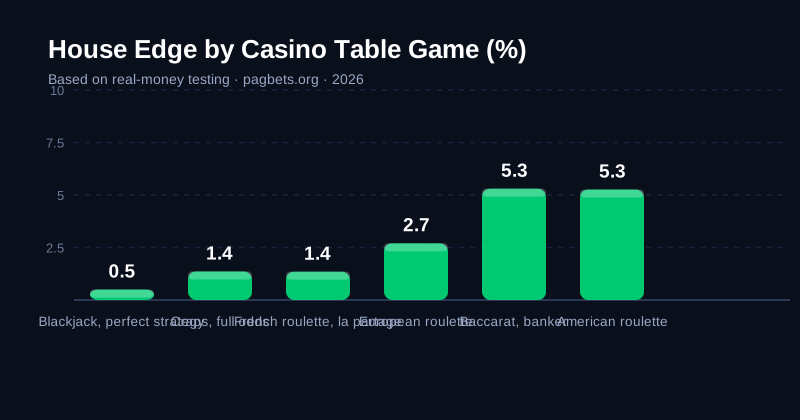
The house edge is the casino's average profit as a percentage of every wager, and it varies more widely across table games than across any other category in a casino.
The best games cluster below 1%, the middle games sit between 1% and 3%, and the worst reach 5% or more. That spread is the single most important fact for anyone choosing where to spend time, because a 3% game costs roughly six times as much per wagered unit as a 0.5% one.
Our house edge guide covers the calculation in full, and the roulette guide shows how one physical difference — a single extra pocket — moves the edge by nearly a factor of two.
| Game | House edge | Category | Notes |
|---|---|---|---|
| Blackjack, perfect strategy | 0.5% | Skill | Best in the casino |
| Blackjack, typical play | 1.5–2% | Skill | Errors cost real money |
| Video poker, strong pay table | 0.3–0.5% | Skill | Can approach even money |
| Craps, full odds | 1.36% | Skill | Pass line, taking odds |
| European roulette | 2.70% | Chance | Single zero |
| French roulette, la partage | 1.35% | Chance | Even-money bets only |
| American roulette | 5.26% | Chance | Double zero |
| Baccarat, banker bet | 5.3% | Chance | Most common bet |
| Three card poker | 2–7% | Mixed | Depends on pay table |
| Pai gow poker | 5.3% | Mixed | Depends on pay table |
Variants Change the Edge More Than Strategy Does
Something specific to table games is that the rules variant frequently matters more than anything a player can do.
Roulette is the clearest case: a French wheel with la partage on the even-money bets has an edge of 1.35%, while an American wheel has 5.26%. No system, discipline or staking plan closes a four-point gap. Blackjack is similar — surrender available reduces the edge by around half a percentage point, and a 6:5 payout on a natural instead of 3:2 raises it by more than a point.
This is why reading the rules on the specific table is worth more than any strategy advice. Our live dealer comparison covers which variants operators typically offer, and the security checklist covers verifying that what is offered is what is advertised.
Games That Genuinely Reward Skill
Three games repay study in a way the rest do not, and it is worth being specific about what that study involves.
Blackjack requires memorising a decision chart. Basic strategy is a lookup table covering every combination of hand total and dealer upcard, and using it correctly reduces the edge to about 0.5%. Card counting can go further, but it is difficult to do well and increasingly restricted.
Video poker requires learning the optimal hold decision for every possible hand, which depends entirely on the pay table. This is genuinely learnable and the return can approach even money at a full-pay Jacks or Better game, which makes it the highest-return game in most casinos for a prepared player.
Craps rewards understanding the pass line and taking odds, which reduces the edge to about 1.36%. It is widely avoided because of its apparent complexity, which is a genuine advantage to anyone willing to learn it.
Where Strategy Cannot Help
On any game of chance, a system changes nothing about the expected return, and it is worth being clear about why.
Independent events have no memory. A run of eight losses does not make the ninth more likely to win, because the probability of each result is unchanged by the ones before it. Changing stake size alters the shape of the loss curve but not its expected direction, and a progression such as the Martingale converts a series of small wins into a single catastrophic loss when the inevitable losing run arrives.
What genuinely changes the mathematics on these games is the rules variant and the payout schedule, not the betting method. Our journal guide makes the same point for sports betting: track the actual numbers rather than relying on a pattern.
- Roulette, European or French over American, nothing else matters much
- Baccarat, avoid the banker bet at 5.3% and play the player
- Slots, pick the highest published RTP, accept the rest
- Progressions, change loss shape not expectation
- Pattern systems, independent events have no memory
- Variance, a better price does not beat a negative expectation
Why the Best Game Is Not the Most Entertaining One
There is a persistent gap between the games with the smallest house edge and the games people actually choose to play, and it is worth being honest about.
Craps has the best odds of any table game with a meaningful player decision, at 1.36% on the pass line with odds, and it is among the least popular. The reasons are largely surface: it has the most bets on the layout, the most to remember, and the loudest table in the casino. None of those are analytical reasons.
Similarly, blackjack with correct strategy returns close to even money, yet many players choose games with five times the edge for the pace or the theme. This is a preference decision rather than a mistake, and the important thing is that it is a decision rather than an accident.
Where it becomes a problem is when players assume a low-edge game and a high-edge game are equivalent because both are 'table games'. They are not. Our house edge guide sets out the arithmetic, and the roulette guide shows what a five-point difference compounds to over a long session.
Table Limits and What They Change
Table limits do not affect the probability of a game, but they change what a session is genuinely about in a way that is easy to overlook.
A game available at €5 to €1,000 and one available at €100 to €30,000 have identical mathematics. What differs is who can play them, and the psychological effect of the numbers moving. At a €5 minimum, a loss of €100 is a serious session. At a €500 minimum, it is a single hand, and the response to a losing run is completely different.
Limits matter most in the context of bonuses, where a maximum bet cap applies. Many bonus terms set a cap of €5 or €2 per hand, and a player who bets above it frequently has that bet contribute only the stake toward the requirement and none of the winnings — which turns a large win into lost progress. Our bonus terms checklist covers this interaction in detail.
The practical rule is to find your intended stake before choosing a table, and to check whether the limits accommodate it. Where they do not, the game is not the game you were planning to play.
Choosing Where to Play
A sensible allocation of time follows the mathematics directly. If you play blackjack, learn the chart properly — it is the highest-value hour you can spend in a casino. If you play video poker, choose a full-pay game and study it. If you enjoy roulette or baccarat, treat it as entertainment with a fixed budget, because the edge is fixed and known.
Whichever you choose, the practical protections are the same: set deposit limits before you start, use a session timer, and check whether table limits suit your intended stake. A game that looks excellent at a £5 table may be entirely inaccessible at the £500 you were hoping for.
Our responsible gambling tools guide covers setting those limits, and the live casino guide covers what changes when the same game is dealt by a dealer rather than a machine.
- Blackjack: learn the chart, it is the best-value hour available
- Video poker: choose a full-pay game, and study it
- Craps: learn the pass line, the edge is worth it
- Roulette: seek European or French, rules beat systems
- Baccarat: play the player, never the banker
- Always, set limits first — our tools guide explains how