
What Crypto Betting Actually Is
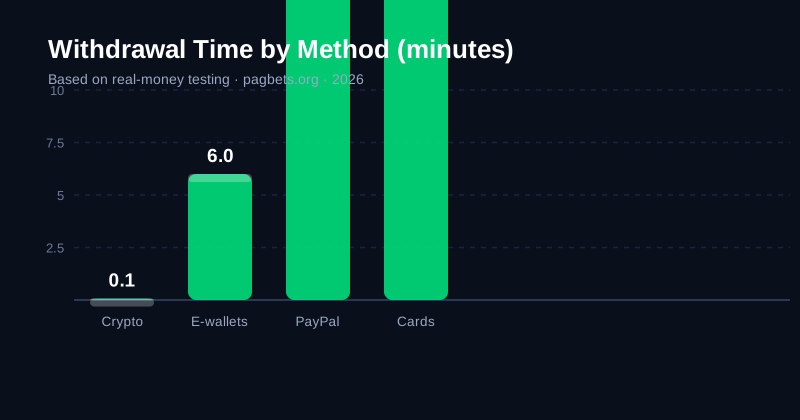
Crypto betting is online gambling where deposits and withdrawals are made in cryptocurrency — Bitcoin, Ethereum, USDT and a dozen others — instead of cards or bank transfers. The appeal is concrete: deposits confirm in seconds, withdrawals complete in minutes rather than days, and at crypto-native operators like Stake, every game result can be independently verified through provably fair cryptography.
The trade-off is equally concrete: you hold your own funds before and after the bet, and crypto mistakes are irreversible. This guide covers the whole journey — buying, storing, depositing, playing and withdrawing — with the security habits that matter.

Choosing Your Coin: BTC, ETH or USDT?
For betting bankrolls, USDT is the sensible default: a dollar-pegged stablecoin with the speed of crypto and none of the price swings. If you bet with Bitcoin, a 10% market move can change your bankroll more than a month of betting results — good if you're also investing, terrible if you just want to gamble.
Bitcoin remains the most universally accepted and is the standard at most crypto casinos. Ethereum, Litecoin and Dogecoin appear widely, with lower network fees on the smaller chains. Whichever you choose, buy it on a reputable exchange and move it to your own wallet before depositing to a casino.
- USDT (Tether): stable value, ideal bankroll coin
- BTC (Bitcoin): widest acceptance, volatile
- ETH (Ethereum): widely accepted, higher fees
- LTC / DOGE: cheap and fast for small transactions
Wallet Setup: The Security Layer That Is Entirely Yours
Your crypto wallet is the single biggest security variable in crypto betting. Two rules prevent almost every disaster: enable two-factor authentication on both your wallet and your betting account, and never share or screenshot your seed phrase — it is the master key to your funds. For casino use, a reputable software wallet (with 2FA and backup phrase stored offline) is practical; for larger balances, a hardware wallet is the standard.
Depositing, Playing and Withdrawing
The flow is simple once set up: copy the casino's deposit address, send from your wallet, and play — deposits at Stake typically credit within a minute. Withdrawals reverse the process and are the headline benefit of crypto betting: our measured Bitcoin withdrawal at Stake took 40 seconds, and USDT arrived in under a minute. No pending periods, no bank processing days.
One caution: always double-check the deposit network (BTC vs USDT on ERC-20 vs TRC-20). Sending USDT on the wrong network is the most common crypto betting mistake, and those funds are usually unrecoverable.
| Step | Time we measured | Notes |
|---|---|---|
| Exchange → wallet | 10–30 min | Buy the coin first |
| Wallet → casino deposit | Under 1 min | Confirm network matches |
| Casino → wallet withdrawal | 40 sec – 1 hour | Fastest in gambling |
| Wallet → exchange (cash out) | 10–30 min | Optional; tax events may apply |
Provably Fair Games: The Crypto Difference
Crypto-native casinos introduced provably fair gaming, and it's the strongest reason to prefer them. Before each round the casino commits to a server seed; your client provides a seed too; after the round you can verify the combined hash and confirm the result was predetermined and untampered. Stake's Originals (Dice, Crash, Plinko, Mines) all support this verification in two clicks. Traditional fiat casinos simply can't offer this guarantee.
The Best Crypto Betting Sites in 2026
Stake remains our top-rated crypto operator — instant payouts, provably fair originals, a full sportsbook — with a 4.7/5 in our testing. Among hybrid bookmakers, 1xBet, Melbet and Mostbet accept crypto alongside fiat, which is convenient if you want one account for both. Full comparisons in our rankings.
The Risks, Stated Plainly
Crypto betting concentrates risk in three places: self-custody (lose your keys, lose your funds — no support desk can help), irreversibility (no chargebacks, ever), and volatility (unless you use USDT). None of these are reasons to avoid crypto betting — but they are reasons to follow the wallet rules above, keep only your betting bankroll in the wallet, and treat every address as a one-way door.

Fees, Networks and the Hidden Cost of Moving Coin
The headline advantage of crypto betting is speed, and speed has a price that appears as the network fee. Bitcoin transactions typically cost between $1 and $10 depending on congestion, Ethereum considerably more, and stablecoins on cheaper networks a fraction of either. On a $50 deposit a fee of $2 is 4 percent, which is more than the margin difference between a good and an average sportsbook. On a $500 deposit it is negligible noise, and that is roughly the threshold at which crypto becomes worth the inconvenience.
Choosing the network is the lever most people miss entirely. Sending USDT over TRC-20 rather than ERC-20 typically costs well under a dollar instead of several dollars, and the same pattern holds across many other assets on multi-chain exchanges. The catch is that operators do not support every network for every coin, so check the deposit page before buying rather than after. Our USDT betting guide covers the network options and the mismatch cases in detail.
Withdrawal fees follow the same pattern in reverse, and the exchange rate is the other hidden cost nobody accounts for. Converting a volatile coin back to fiat at the wrong moment moves your bankroll independently of your betting results, which is the core reason this guide defaults to a stablecoin for betting balances. If you do hold BTC and bet with it, treat the price exposure as a separate decision from the bet itself and size it accordingly rather than pretending it is not there.
One more cost is easy to miss because it is not a network fee at all. Some platforms charge their own withdrawal fee on top of the network charge, and some minimum withdrawal thresholds are set high enough that the fee becomes material on smaller balances. A $50 threshold with a $5 fee is 10 percent of a first withdrawal, and those thresholds are frequently buried in the payments page rather than displayed on the cashier screen where you are actually depositing.
The general rule is simple and worth applying before you commit: calculate the round-trip cost on your actual stake size before choosing crypto, not after your first withdrawal. The crypto casino payment guide covers those thresholds and fee structures in detail, and the difference between a well-chosen route and a careless one is frequently larger than the entire benefit you were buying.
Choosing Between a Hybrid Bookmaker and a Crypto-Native One
There are two distinct models and they suit different players. A hybrid bookmaker accepts crypto alongside cards and e-wallets, usually through a payment processor, and behaves like a conventional sportsbook with crypto bolted on to the cashier. A crypto-native operator built its product around on-chain settlement, typically with a much larger game catalogue, near-instant withdrawals and a rakeback structure rather than a conventional deposit bonus.
The comparison that matters is withdrawal reliability under load rather than speed at quiet times. A processor-mediated withdrawal on a hybrid site can take hours while the payment provider completes its own checks, and those checks sit outside the operator's control entirely. A crypto-native operator pushing directly to your wallet has fewer steps and a much shorter chain, which is why our measured 40-second Bitcoin withdrawal came from the crypto-native model rather than the hybrid one.
The trade-offs run the other way too. Crypto-native sites rarely hold a tier-one licence, so the protection position described in our licensing guide is materially weaker than at a regulated European bookmaker. They also tend to carry a much higher gambling volume on the same platform, which for some players is a genuine problem rather than a neutral fact about the product, and the difference in self-exclusion quality tends to follow the licensing.
Sportsbook depth is another differentiator worth checking rather than assuming. A crypto-native platform built around casino and original games may offer a thinner mainstream football product than a hybrid bookmaker that earns its revenue from the sportsbook. If your betting is football rather than casino, test the sportsbook depth, the market count and the streaming position before committing a balance, because the headline withdrawal speed says nothing about any of it.
Neither model is better in the abstract, and the honest summary is that they optimise for different priorities. If you want one account for a conventional card deposit, a football accumulator and a crypto withdrawal, the hybrid is the pragmatic choice. If you bet frequently, withdraw daily and play casino games as well as sports, the crypto-native model is measurably better on the points that matter to you.
The Cases Where Crypto Is the Wrong Choice
Crypto is a poor fit in three situations, and recognising them early saves money. The first is a small bankroll. Network fees, the spread on the exchange rate and minimum withdrawal thresholds mean overheads consume a meaningful share of a £50 balance, and the convenience is not worth the friction at that level. Below roughly $200 held in total across betting accounts, a conventional e-wallet is usually cheaper in fees and considerably simpler in practice.
The second is a player who needs a chargeback or a dispute route available. Crypto transactions cannot be reversed and a mistaken transfer to an operator is not recoverable by anyone, anywhere. Anyone whose decision to bet depends on being able to reclaim money should not be using crypto at all, and that is a considerably stronger argument than the usual one about convenience and speed that appears in most comparisons.
The third is anyone whose gambling is showing harm signals. The irreversibility that makes crypto attractive is exactly the property that removes the last stop before a deposit, and being able to convert straight from a wallet makes impulsive depositing simpler rather than harder. Our responsible betting tools guide describes the deposit limits that block that behaviour at a regulated operator, and they are considerably easier to enforce when the money has to pass through a payment provider first.
There is also the purely practical objection that crypto adds two technical steps to an activity that requires none at all. A player who cannot comfortably install a wallet application and manage a receiving address will lose money to errors, and those errors are unrecoverable by design rather than by policy. That is a competence question rather than a character question, and it is worth being honest with yourself about which side of that line you are on before you start.
If crypto is not the right fit, the payment methods guide covers the conventional options in detail. Neither is slower by much in practice, both carry a dispute route that crypto does not offer at all, and the convenience difference is small enough that it rarely justifies taking on risk you had not considered.
✓ What We Like
- Tells you how to check a licence rather than asking you to trust one
- Covers the payment problem that decides whether the product is usable for you
- Explains the tax structure, which is the part that sets the price
- Uses named regulators, laws and figures rather than general description
✕ What Could Improve
- The cheaper alternative is unprotected, and the article is honest about that
- A limit or ceiling constrains how much you can actually stake


