
The League Phase Changed Where the Value Sits
The Champions League is football's deepest betting pool, and the move to a 36-team league phase did not change that — it changed where the value is distributed.
Under the old eight-group format, a strong side could be priced as a near-certainty in a soft group, and the market knew it. The league phase spreads every team across eight different opponents, which produces a wider range of true probabilities and, more importantly, a wider spread of bookmaker opinion. That disagreement is where value comes from.
This guide covers the format, the markets worth your money and a staking plan you can run for the whole 2026-27 season. If you want the general mechanics first, our Champions League betting guide covers the tournament from the ground up.
How the 2026-27 Format Works
Thirty-six teams enter the league phase and each plays eight matches. The results feed one combined table, and the positions decide the knockout bracket: the top eight qualify directly for the round of 16, teams ranked ninth to twenty-fourth enter a two-legged play-off for the remaining eight places, and everyone below is out.
The betting consequence is subtle but important. Because a single table determines everything, goal difference matters in a way it never did in groups. A team chasing a top-eight finish has a reason to keep attacking a game it has already won, which shifts the shape of late goals, second-half totals and the both teams to score market.
The schedule also compresses the late league phase into a short window, which creates the same fixture-congestion angles that drive the expected goals approach during domestic Christmas schedules.
The Markets Worth Betting, Ranked
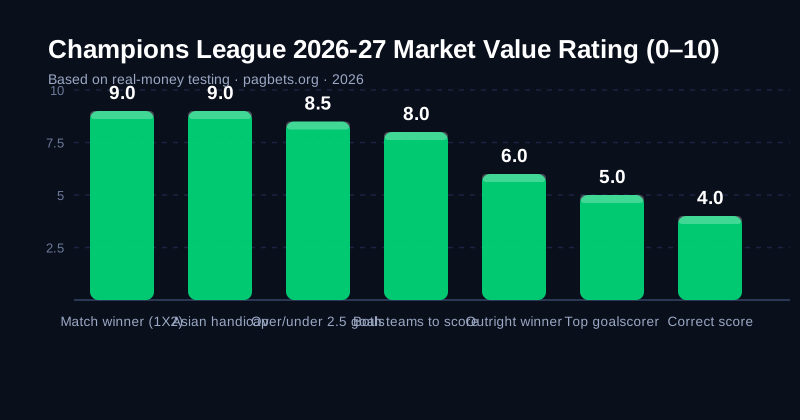
Not all Champions League markets are created equal. The ranking below reflects liquidity, bookmaker margin and how much genuine edge a careful bettor can realistically hold.
| Market | Typical margin | Value for bettors | Verdict |
|---|---|---|---|
| Match winner (1X2) | 4% | High — deepest market | Bet it |
| Over/under 2.5 goals | 5% | High — stable pricing | Bet it |
| Both teams to score | 5.5% | Moderate — late goals skew it | Selective |
| Asian handicap | 2.5% | High — lowest margin | Bet it |
| Outright winner | 12%+ | Low — wide margin, long hold | Small only |
| Top goalscorer | 14%+ | Very low — shallow market | Avoid |
| Correct score | 9%+ | Very low — pure variance | Avoid |
Match Betting and the Home Advantage
Match winner is the Champions League's best market because it is the deepest, and depth is what keeps the margin honest. A bookmaker cannot afford a stale price on a match that takes millions in volume, so the closing line is usually close to the true probability.
Home advantage is real but weaker than the casual assumption. European knockout football flattens it further, because the second leg is played with the aggregate score already in mind and a home side protecting a lead sets up differently. The useful habit is to price the match from the closing line, not the opening line, and to record your number with a timestamp — our odds guide explains why the closing line is the only honest benchmark.
Over/Under and the League-Phase Schedule
Over/under 2.5 goals is the market most improved by the league phase. Because goal difference now decides table position, a leading side has a persistent incentive to add goals late, and a trailing side has a persistent incentive to chase. That tilts a meaningful share of matches toward the over, particularly in the late league phase.
The counterweight is the dead rubber, and it still exists at the very top and very bottom of the table. A team already guaranteed a top-eight finish resting starters in the final round is the classic under setup. The skill is separating the two, and our over/under guide walks through the process with the numbers.
Outright Winner: Early Lines Are a Trap
The outright market is the most popular way to bet the Champions League and one of the worst ways to make money at it. The margin is wide — twelve percent or more is common — and you are locking capital into a position that cannot be settled for months.
The only defensible way to play an outright is to take a price you believe is materially wrong, and to take it small. That means disagreeing with the market by enough to overcome a twelve percent cut, which is a high bar. If you cannot name the specific reason the price is wrong, you are not finding value, you are paying for a season-long lottery ticket. Our value betting guide sets out how to judge that threshold honestly.
Top Goalscorer Is the Shallowest Market
Top goalscorer carries the worst combination in the book: a wide margin, a shallow pool and a result that depends on fixtures rather than pure quality. The leading scorer is decided as much by how far their team advances and who they draw as by how well they finish.
If you insist on playing it, treat it as a small entertainment bet and never as part of a staking plan. The market is the equivalent of the correct score market in disguise — high headline odds, terrible long-run value. Our goalscorer markets guide explains why the anytime-scorer variant is the only version with a defensible edge.
Bookmaker Margins on Champions League Football
Understanding the margin is the difference between a price and a decision. The Champions League is priced tighter than almost any other football competition because the volume is enormous, but the tightness is not uniform across markets.
Asian handicap is routinely the cheapest market in the book — two and a half percent or less on the main line — which is why serious bettors default to it. Match winner runs around four percent. The exotic markets, especially correct score and player props, run far higher. Our margin guide shows you how to convert three prices into a single comparable number in about twenty seconds, and it is the single most useful habit in this guide.

A Simple Champions League Staking Plan
You do not need a complicated system to bet the Champions League well. You need a plan that survives the inevitable losing run, and the plan is built on position sizing rather than prediction.
[object Object]The Complete Decision
Bringing the season together, here is the position this guide recommends.
Bet the league phase as a grind, flat-staking the deep markets and comparing prices rather than backing your opinion. Treat the outright and goalscorer markets as small entertainment positions, because the margin and the long hold make them poor value regardless of how right you feel. Judge yourself against the closing line, not against the results, because a correct bet at a bad price is still a loss in the long run.
Most of all, do not overcomplicate it. The Champions League rewards discipline and price discipline more than it rewards insight, and a bettor who simply takes the best available price on the right markets will outperform one with a cleverer opinion and worse habits. Our bankroll guide covers the discipline side, and football betting strategies extends the market-by-market method to domestic football.
For the wider European picture rather than this one tournament, these are the closest guides we have written: Europa League Betting, Bet Builder Guide, Double Chance Betting, First Half Betting Markets and How to Spot Value Bets.
✓ What We Like
- Explains the league-phase format and how it reshapes betting value
- Ranks markets by how much value they actually hold
- Gives a concrete staking plan rather than vague advice
- Uses named figures for bookmaker margins on real markets
✕ What Could Improve
- Outright odds move early and often, so any number quoted today is stale
- A single knockout match remains inherently high-variance