What Live Casino Actually Is
Live casino is a physical casino studio streamed to the player, with a real dealer operating real equipment. The blackjack is dealt from a real shoe, the roulette ball is spun on a real wheel, and the outcome is genuinely physical.
It is worth being clear about what that does and does not change. The mathematics is exactly the same as the computer-generated version of the same game under the same rules — the dealer's decisions follow a fixed procedure, and no skill or judgement enters into the result of a hand of blackjack or a spin of roulette. The camera changes the presentation, not the probability.
What it genuinely changes is pace. A live hand of roulette takes about 45 seconds against roughly four for the online version, and that single difference alters how the games feel, how quickly people play, and therefore how much money they lose over an evening. Our live dealer site comparison ranks operators on the practical factors.

Variants Matter More Than Strategy
Because live casino is largely a presentation layer, the most useful thing a player can do is compare variants of the same game and pick the one with the better rules.
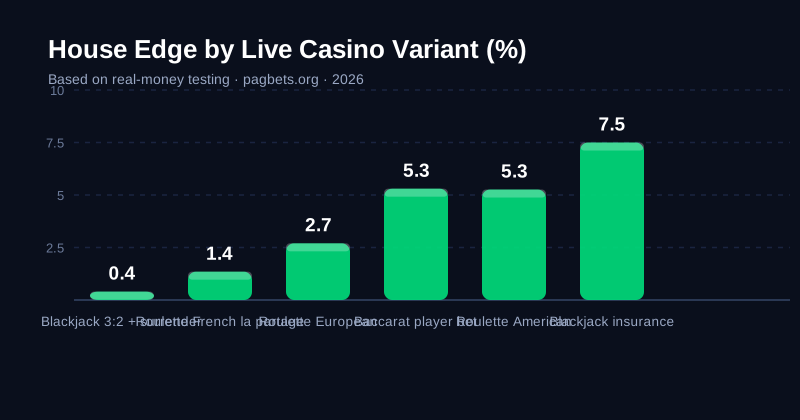
On roulette, a European wheel is 2.70% and an American wheel 5.26%, and a French table with la partage takes even-money bets down to about 1.35%. Those differences dwarf anything a betting system achieves. On blackjack, surrender available reduces the house edge by roughly half a percentage point, and a 3:2 payout on a natural is worth about 1.6% against the 6:5 alternative.
The reason to check is that sites advertise 'live roulette' or 'live blackjack' without specifying the rules, and the tables within a single lobby frequently differ. Our roulette odds guide and blackjack strategy guide both cover the variants in detail.
| Game | Better variant | House edge | Worse variant | House edge |
|---|---|---|---|---|
| Roulette | French (la partage) | 1.35% | American | 5.26% |
| Blackjack | 3:2 payout, surrender | 0.4% | 6:5 payout, no surrender | 1.9% |
| Baccarat | 8-deck banker bet | 1.06% | 6-deck banker bet | 1.24% |
| Poker | Full pay tables | Varies | Short pay Jacks+ | Up to 10% worse |
Betting Timers and Other Pressure Mechanisms
The most common complaint about live casino is the betting timer. Many tables give a short window to place bets, and if it expires the round is simply lost. There is no fairness reason for this — a player should be able to take as long as they reasonably need, and the dealer is waiting for them anyway.
It is a retention mechanism rather than a game rule, and it is most aggressive on the low-limit tables where casual players sit. The workaround is straightforward and worth adopting: place your bet before the previous round resolves, and use the time between hands to decide rather than to act.
Minimum bet levels are the second pressure tool. A €5 minimum on a game with a €0.50 bet is a large multiplier, and it means casual players must either raise their stake or leave. Our casino etiquette guide covers the broader behavioural expectations at live tables.
- Short betting timers, place bets between rounds, not during
- High minimum bets, check before sitting down
- Limits change mid-session, they often do
- Side bets pushed by the dealer, these carry a much higher edge
- Camera angles, a poor view of the table is a genuine disadvantage
- Audio delays, a real disadvantage in live blackjack
Live Blackjack and the Element of Player Choice
Live blackjack is the one live game where a player decision genuinely affects the result, and it is the one where playing well is actually possible.
The rules differ from online blackjack in one important respect: the dealer takes a real time pause before revealing, usually 15 to 20 seconds, and the table minimum applies per hand. This means basic strategy is more clearly rewarded than in any other live game, because you are making the same decisions as at a land casino and the same reasoning applies.
The blackjack basic strategy chart transfers directly. The advantage of playing live rather than online is that you can see the shoe and count cards, which is not possible online. Whether counting is permitted varies by jurisdiction and by table, and in a live casino it is generally tolerated because the game is designed to be beatable by a small margin.
What to Avoid
Several things in the live casino lobby are worth approaching carefully.
Slot-style live games — titles like 'live blackjack' or 'live roulette' that are actually a slot game with a dealer on a video feed. They are slots, they carry a slots-sized margin, and the live presentation is designed to suggest a table game. Pre-recorded streams are the second issue: a video loop presented as live, which is misleading and in regulated markets not permitted. A genuine live table accepts bets until the round starts and shows the shuffle.
Beyond those, be careful of side bets pushed by the dealer. Blackjack bonus, three card poker bonus and the insurance bet all carry substantially higher margins than the base game, and they are the primary mechanism by which live tables generate their revenue. Our casino security checklist covers assessing whether the operator itself is legitimate.
- Slot-style 'live' games, check the rules, not the label
- Pre-recorded streams, a real table shows the shuffle
- Insurance and bonus side bets, a far higher edge than the base game
- Martingale and other progressions, they do not work live either
- Rushing decisions under timer pressure, it is a pressure mechanism
- Chasing a live loss, a losing hand is a losing hand
Why Live Casino Exists at All
It is worth understanding what live casino is for, because it explains both the design choices and the pressures that produce them.
Live casino exists to solve a trust problem. A player who believes a computer-generated result might be fixed has no way to verify it, and the live format removes that doubt entirely: you can see the shoe, you can see the wheel, and you can watch the shuffle. That perceived integrity is the product.
It also serves a commercial purpose for the operator. Live tables carry a larger margin than online games, and the slower pace is a feature rather than a limitation — a session that runs at a fraction of the speed reaches a satisfying conclusion for the operator in roughly the same wall-clock time as a much longer, lossier online session.
The tension between those two purposes explains most of what players dislike. The minimum stakes, the betting timers and the dealer's side-bet suggestions all serve the operator's economics rather than the player's interest, and they are the reason our live dealer comparison weights table limits and timer length as heavily as game variety.
A Sensible Approach
Decide in advance what you are playing for, and the money should be an amount you would have spent on the game regardless. Live casino is not a way to win — it is a more engaging version of the same mathematics, and the engagement is the risk.
Play with a clear unit, check the rules on the specific table before you start, and use the time between hands to make decisions rather than to react. If you play blackjack, use the strategy chart. If you play roulette, seek the French rule with la partage. If you play baccarat, avoid the banker bet and play the player.
Set firm deposit and session limits with our responsible betting tools guide before you join a table — live tables are precisely the environment in which a limit set beforehand is worth the most.
- Decide your stake and session length in advance, before joining
- Read the table rules, variants differ in edge size
- Play between hands, use the pause to think
- Use blackjack strategy, it transfers directly to live
- Seek French roulette rules, a genuine edge difference
- Avoid side bets, they carry a far higher margin
- Set limits with our responsible betting tools before you sit down