What each method is realistically for
There are effectively four options and they are not interchangeable. Each does one job well.
Most confusion about betting payments in Pakistan comes from treating the whole thing as a card problem. It is not a card problem. It is a name-matching problem wrapped in a rails problem, and the two failures look similar from the outside while having nothing to do with each other. Every betting account has a single identity attached to it: the name on the identity document you verified with. Deposits can be loose about that. Payouts absolutely are not. So the pattern you get is a site that accepts your deposit happily through four different methods and then tells you, three days later, that it can only pay out to a bank account in your own name.
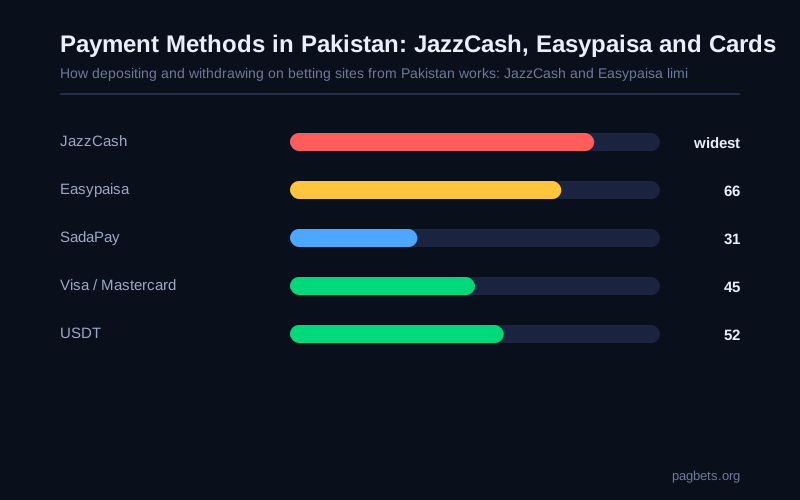
The table below ranks each method by what it is realistically for, and the right-hand column is the one that matters. People pick the wrong rail by reading deposit convenience and ignoring withdrawal inconvenience. Five of the six rows have a convenient deposit column and a difficult withdrawal column, which is the whole of the local payments problem in one table, and it is why the recommended setup at the end of this guide involves two separate pieces of infrastructure rather than one.
| Method | Deposits | Withdrawals | Realistic use |
|---|---|---|---|
| JazzCash | Works, seconds | Rarely supported | Small to mid deposits |
| Easypaisa | Works, seconds | Rarely supported | Small to mid deposits |
| Bank transfer / IBAN | Works, hours | Often supported | Balancing deposits out |
| Bank card / Visa-Mastercard | Declines often | Card payout needs matching bank | Where issuer permits it |
| SadaPay | Works via IBAN | Same as any IBAN | The bank account to hold winnings |
| USDT / crypto | Not supported | Usually supported | Moving size out |
The pattern to notice
Five of the six rows have a convenient deposit column and a difficult withdrawal column. That is the whole of the local payments problem in one table, and it is why the recommended setup at the end of this guide involves two separate pieces of infrastructure rather than one.
JazzCash and Easypaisa: Fast In, Difficult Out
These two carry the great majority of small deposits in Pakistan, and for a Pakistani bettor there is no serious alternative. JazzCash operates a far wider agent and top-up network, including Telenor alert balance top-ups, which matters enormously in a country where a meaningful share of users are on feature phones or on handsets with limited data. Easypaisa has a comparable merchant network and a comparable app. Both are, in the ordinary sense, excellent products.
Neither is a good payout rail, and the reason is structural. A betting operator paying out to a mobile wallet is making a transfer into a consumer account held by a non-bank institution, and that raises a verification problem the operator cannot fully solve. When a payout arrives at a wallet registered to someone else, the operator has no way to establish whose money it was. Most therefore offer the wallet on the deposit side only.
The ceilings are the other constraint. Mobile wallet transfer limits differ by wallet tier, by whether the sending account is bank-backed or Telenor-backed, and by whether the transaction is in-app or agent-assisted. Expect in-app single-transfer ceilings in the low tens of thousands of PKR and higher limits requiring a tier upgrade. Agents can move more, at the cost of a visit and a fee. The practical rule is that anything above roughly PKR 50,000 in one go belongs on a different rail.
Our the fast withdrawals guide covers the verification side, and the payments guide has the mechanics for each rail.
Why Card Deposits Decline on Roughly Half of Attempts
Card deposits fail far more often in Pakistan than in most markets, and in almost every case the decline comes from the issuer side rather than the site. Three mechanisms account for the bulk of it.
Merchant category blocking. Card issuers in Pakistan maintain blocklists by merchant category code, and gambling is a category several banks block by default. The request leaves your bank, the bank recognises the category, and the transaction is refused before it ever reaches the operator. You get a decline with no useful detail and an operator support desk that has no idea why.Offshore counterparty rules. A card issuer that permits gambling generally still permits gambling with a local licensed merchant. An international processor in an offshore jurisdiction looks different, and the descriptor on the statement will not read like a Pakistani retailer. Some issuers decline on that basis alone.
Operator-side jurisdiction rules. Some books will only accept cards issued inside the jurisdiction they are licensed in. If that applies to the site you are on, no card of yours will ever work, and trying several is just noise in your bank's fraud monitoring.
One further trap deserves naming because it costs real money: the currency conversion charge. A PKR-denominated card transacting in EUR or USD pays a markup that commonly runs between 1.5 and 3 per cent, charged by your issuer and sometimes again by the network. On a PKR 20,000 deposit that is PKR 300 to PKR 600 gone before the balance lands, and it comes back as a line on your statement rather than as a fee the site discloses.
The Name-Match Rule, Explained Properly
This is the single most common reason a winning Pakistani bettor cannot get paid, so it is worth being precise about it rather than vague.
The operator holds a verified identity. The payout rail holds an identity. If they are not the same person, the operator is not able to establish that it is paying the right person, so it stops. That is the whole rule. There is no appeal to goodwill at a level where the compliance function is paying attention.
Here is where it actually bites in Pakistan.
A JazzCash wallet in a relative's name. The single most common case. Dad opened the wallet because he had the CNIC when the account was set up; you have been depositing and withdrawing on your own bookmaker account ever since. Identical surname, different person.A business account used personally. A trader's or shop's bank account is a common destination for payouts. Unless you are a signatory on it and can evidence that, it is a mismatch.
A family member quietly fixing a failed payout. The withdrawal fails, the account holder is abroad or busy, and someone else pays it into their own wallet. The site now has a payout record against a name that is not yours, which is a bigger problem than the delay would have been.
A CNIC issued in a different province. Not a name mismatch, but it triggers manual review, so expect a slower first payout. Providers verify provinces and provinces do not always share records cleanly.
Our the KYC guide covers what documents operators ask for and in what order, and the complaints policy page sets out the escalation route when a payout is genuinely stuck.
SadaPay and the Case for a Second Piece of Infrastructure
SadaPay is a free app that behaves like an ordinary Pakistani current account: you get an IBAN, an app and a Mastercard debit card, with no minimum balance and no monthly fee. For betting purposes the relevant fact is not the card. It is that it gives a verified Pakistani account holder a proper IBAN in their own name, cheaply, in about ten minutes.
That matters because the withdrawal half of the problem then becomes ordinary rather than exotic. An IBAN in your own name is what the majority of betting operators can pay out to, and SadaPay supplies one where a conventional current account would need documentation, a branch visit or a minimum balance. The Mastercard is a side benefit and often a disappointment: being a Mastercard issued in Pakistan, it usually carries the same merchant-category blocking as any other local card.
So the sensible setup, and the one I would actually recommend, is a JazzCash or Easypaisa wallet for getting money in, and a named IBAN for getting money out. Two tools, each doing the job it is good at. Mixing them into one expectation is what generates the disappointment.
Crypto: the Payout Rail That Works and the Deposit Rail That Usually Does Not
Crypto in this arrangement runs in one direction only. Nearly every bookmaker that supports Pakistani players will pay out in USDT and almost none will take a crypto deposit, because funding a player balance with crypto requires their own exchange and counterparty relationships in a market many of them have exited. So the flow is bank or wallet in, bookmaker balance, USDT out, and then your problem.
USDT on Tron is the practical choice here. TRC20 transfers cost roughly a dollar, against thirty to sixty dollars for an ERC20 transfer at a bad moment, and the network has been the default rail for Pakistani peer transfers for years. The USDT betting guide covers the network choice, and the crypto payments guide covers the conversion mechanics.
Now the part the promotional framing leaves out. There is a minimum network fee on the outgoing transfer. The conversion back to PKR goes through an exchange, which charges a spread and may charge a fee on top, and depending on the provider your account may need to be source-of-funds cleared before it will convert. And the value moves while you are doing all of this, so a withdrawal taken at the top of a rally arrives as fewer rupees. Four costs, all small, all real, all of which should be counted before the method is called cheap.
Our how to choose a bookmaker covers checking the payout terms before committing, and the crypto betting guide covers the wider picture including volatility.
What a Realistic Setup Costs
Here is what the friction actually looks like in rupees, using a PKR 30,000 round trip as the example. I have used round numbers because precision here would be false confidence — provider fees move. The headline number is not the deposit fee. It is the sum of the conversion spread, the network fee and the time you spend waiting for verification to clear before you ever bet. A mobile wallet in and a bank transfer out costs close to nothing and takes about a working day. Crypto costs around PKR 700 in fees on this round trip and may take two to four days, which is why it earns its place when the amount exceeds what local rails will move in one go rather than as a routine payment method. The card line below is the one to read twice: PKR 450 to PKR 900 in issuer markup on PKR 30,000, spent before the bet was placed and invisible on any promotional page.
Friction cost of a PKR 30,000 round trip
The headline number is not the deposit fee. It is the sum of the conversion spread, the network fee and the time you spend waiting for verification to clear before you ever bet.
| Step | Typical cost | Notes |
|---|---|---|
| Wallet top-up from bank | PKR 0–50 | Free at most banks, free at agents |
| Wallet to bookmaker transfer | Usually waived | Often used as a deposit promo hook |
| Bank transfer in | PKR 0–100 | Cheque charges apply above thresholds |
| Bank card in | PKR 450–900 | Issuer FX markup, plus possible decline |
| Card FX markup on payout | 1.5–3% | Charged by your issuer, not the site |
| USDT network fee out | PKR 250–400 | TRC20, rises when congested |
| Exchange spread back to PKR | 0.5–1.5% | Provider dependent, larger on OTC desks |
| Crypto value move | Unpredictable | Two to four days exposed |
What the numbers add up to
Across that table, the total friction on a PKR 30,000 round trip is between PKR 700 and PKR 2,300 depending entirely on the rail. Crypto is not the cheap option it is often sold as; it is the cheap option relative to moving PKR 200,000 in one transaction, where the same fixed costs become negligible percentages.
Minimums, Timelines and Where They Bite
Four operational details cause more frustration than fees do, so they are worth listing separately.
Minimum deposit versus minimum bet. These are different numbers and confusing them wastes time. A site will happily take a PKR 300 deposit and then reject a PKR 100 bet on a market you wanted. Small stakes are usually fine on cricket; the constraint is more often on virtual sports and casino round minimums.Verification order. The most common expensive mistake is betting before verifying. Once a payout requires verification, you lose days and often lose the promotional offer attached to the withdrawal. Complete verification immediately after registration, while you are not waiting on anything.
First-payout delay. The first withdrawal is almost always slower than the tenth, because the operator is confirming your payout rail matches your verification. After that, an IBAN payout is often same-day or next-day.
Rejected mid-session. If a site loses a payment provider partway through your session, the deposit can bounce while you have an open bet. Settling an open bet from a bounced deposit is a genuinely awkward conversation. Our the betting limits guide covers related constraints.
A Practical Routine That Works
Everything above compresses into six habits.
Open a named IBAN before you bet anything. SadaPay takes about ten minutes and removes the single most common payout failure. Do it first.Verify the account the day you register. Not before you need it. The delay lands when a payout is pending and costs you the goodwill of the support desk.
Use one wallet for everything. JazzCash and Easypaisa for deposits. Stop looking for a wallet payout that most operators will not offer.
Stop retrying declined cards. Three declines on the same merchant triggers your bank's own fraud monitoring and can make the fourth attempt worse.
Use crypto to move size, not for convenience. TRC20, a known-good exchange account, and a source-of-funds question you can answer.
Withdraw in more than one go. A large single payout attracts more review than two ordinary ones. It also proves the rail works before you need it to.
The Bottom Line on Betting Payments in Pakistan
The local rails are good enough for most of what Pakistani bettors actually do, which is depositing in modest amounts and playing cricket markets. The genuine gap is on the way out, and the gap is not about fees. It is about the withdrawal side of the industry being built around bank accounts and international transfer networks rather than around mobile wallets.
That is why the recommendation in this guide is two tools rather than one: a mobile wallet to get money in, and a properly named bank account to get money out. Crypto fills the third gap, which is size, and costs real money to fill it. Our the best betting sites ranks operators on payment method support specifically, and the casino payments guide covers the same ground for casino balances.