Why Fake Betting Sites Are Hard to Spot
The first thing to understand is that fake sportsbooks are not crude. They run real betting software, display real live odds pulled from a legitimate feed, host real customer service agents on WhatsApp, and copy the layout of a known brand closely enough that the visual differences are difficult to spot on a phone screen.
What they cannot fake convincingly is the paper trail: a genuine licence on a regulator register, a corporate entity with a verifiable address, a domain that has been registered for years rather than weeks, and a payment processor willing to sit behind a real bank account. Every fake betting site eventually fails on one of those four.
This is why the useful checks are legal and financial rather than visual. A polished site with excellent odds is exactly what a scam looks like, because the odds are easy to obtain and the polish is cheap. The licence is not.
Our security checklist covers the general principles, and this article focuses on the specific failure modes we see in the Indian market.
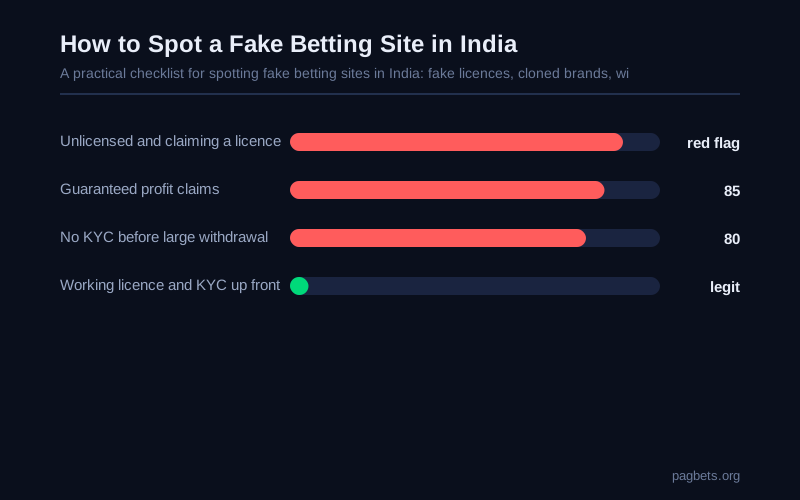
The Red Flags, Ranked by How Often They Appear
Drawn from our own review queue and from reported cases. The first three catch the large majority of fraudulent sites.
| Red flag | How often seen | Why it matters | How to check it |
|---|---|---|---|
| Licence number not on the regulator register | Very common | No real oversight exists | Look the number up on the regulator site itself |
| Domain registered recently, or odd TLD | Very common | Site exists only to take deposits for months | Check domain age in a WHOIS lookup |
| Withdrawal request sits pending after KYC | Very common | The classic scam endpoint | Withdraw Rs 500 before betting anything |
| Bonus above 300% with 40x wagering | Common | The bonus is unachievable by design | Assume a real bonus is under 10x on sports |
| WhatsApp-only customer support | Common | Support vanishes once you ask to withdraw | Email support should exist and be answered |
| Clone of a known brand name | Common | Brand name is the only thing borrowed | Type the brand directly rather than following a link |
| No corporate entity or address in the terms | Occasional | Nobody is legally accountable | Read the footer, not just the homepage |
| Odd payment methods only, no UPI | Occasional | Avoids the local payment trail | UPI and cards are the norm for real operators |
| Very generous odds on obscure markets | Occasional | Odds are set to attract deposits, not to be honest | Compare a price against a known book |
Check the Licence on the Regulator Register
This is the check that separates a real operator from a fake one, and it takes about two minutes if you know where to look.
Every genuine bookmaker displays a licence number in the site footer, often alongside a regulator logo. The critical step is the one people skip: you do not verify the number on the site, because the site can display any number it likes. You take the number and enter it into the issuing regulator own public register.
Licences that appear on genuine sportsbooks serving international customers come from a small set of jurisdictions: the Malta Gaming Authority, the UK Gambling Commission, Curaçao (via the regulator operating there), Anjouan, Kahnawake and a handful of others. Each publishes a register searchable by licence holder or domain. If the number in the footer does not appear in the register, or appears against a different company name, you are looking at a fake site.
Two complications worth knowing. Some operators hold multiple licences and are more properly supervised by a stricter one than the number in the footer suggests. And some fraudulent sites use a real licence number belonging to an unrelated company that genuinely holds one; checking the entity name as well as the number catches that. Our guide to gambling licences covers how each regulator register works.
The Domain and Corporate Checks
The domain is the second filter, and it catches things the licence check misses.
Look at the address bar, not the logo. Genuine operators use clean, established domains, often matching their brand name. Fake sites use strings full of hyphens, numbers and keywords, which is the direct output of a search advertising campaign: someone bidding on betting keywords and needing a landing page per campaign. Newly registered domains are common. So are unusual country-code TLDs and recently launched generic TLD extensions.
Check the domain age with a WHOIS lookup. Anything registered within the last six months deserves suspicion, and anything under three months is a strong signal. The check is free and takes ten seconds.
The corporate check is the third. Every credible operator names a company entity in its terms and conditions, with a registered address, and names the regulator whose rules it follows. A site with no company named in the footer is a site where nobody is legally accountable if your money does not arrive. A site that names a company whose address is a mailbox service, or whose registered name appears nowhere else online, is in the same category.
The Withdrawal Trap, and How to Avoid It
Almost every fake betting site we have seen follows the same arc: an easy bonus, a smooth small withdrawal, and then a large withdrawal that never completes.
The pattern is deliberate. Some fraudulent sites will even pay out a small amount, usually Rs 500 to Rs 2,000, to establish that the site pays. This is cheap relative to the deposits it attracts and it converts sceptics into promoters. The large withdrawal is where the site either stops responding or invents a verification requirement, an unpaid tax charge, a fee that was not disclosed, or an arbitrary play-through requirement on your balance.
The defence is simple and costs nothing: withdraw a small amount early. Do it before you have a meaningful balance, before the site knows you are a regular, and ideally before you have deposited more than you would comfortably lose. If a fresh, verified account pays Rs 500 within a stated timeframe without argument, you have real evidence. If it does not, you have saved yourself considerably more than Rs 500.
Our guide to fast withdrawals sets out realistic timeframes, and the KYC guide covers the verification requirements they will claim are blocking you.
India-Specific Angles: UPI, WhatsApp and the Second Stage
A few fraud patterns are specific to the Indian market and worth knowing by name.
The UPI identifier problem. Depositing to a site hands over your bank account number and your name permanently. A fake site is perfectly entitled to keep it, and it will. You cannot claw that back through your bank because the payment itself was authorised by you.
WhatsApp support as a warning sign. WhatsApp is convenient for a real operator and completely inappropriate for an international one, because there is no record, no account tie-in and no way to escalate. Support that exists only on WhatsApp is a support function that can disappear in a single message.
The second-stage scam. If you complain to a fake site, the likely response is a demand for an additional verification fee, a tax charge, a deposit to release funds, or an agent who offers to help you recover your balance for a commission. This is a well-established pattern and it targets people who have already been defrauded and are looking for help. No legitimate operator will ever ask for money to release winnings, and no recovery agent working for a fee can move money from a site that will not.
App-store absence. Absence from official stores proves nothing, since gambling apps are not distributed there anywhere useful. But a genuine operator will typically have a working, downloadable web app and will not send you an APK from a link in a chat.
What To Do If You Have Already Been Defrauded
If you are in this position, act rather than hope. Contact the site in writing and request a withdrawal, keeping every message. Contact your bank or UPI provider immediately and raise a dispute using the merchant reference number; under NPCI rules a grievance must be acknowledged within three working days, and a fraud report is treated differently and more seriously than a service complaint. Report the site and its payment details to the cybercrime portal and to your local police, and preserve the transaction records, screenshots and the registered domain name, because the domain is the single most useful piece of evidence for a fraud investigation. Do not pay anyone who offers to recover the funds for a fee. Do not send additional money to the site under any circumstances, on any pretext, including a supposed verification fee.
Cloned Brands and Lookalike Domains
The most common scam in this market is not an obviously fake site. It is a site that borrows the name of a real one, and this is worth separating out because it defeats the instinct to check the brand name at all.
The pattern is straightforward: a real operator called something ordinary, then a site with a near-identical name, a logo that is a few pixels different, and a domain that adds a hyphen, a numeral or a plausible word such as bonus, official or login. The typographic error is deliberate and tiny, so it survives on a phone screen.
The defence is simply to type the domain yourself rather than following any link. Not the link in the advert, not the link in the message, not the sponsored result at the top of the search page. If a genuine operator exists, you can reach it by typing its name. If you cannot reach it without following a link they gave you, you are already looking at the wrong site.
Two further checks apply. Look at the logo and the spacing: genuine operators are consistent across their site, and clones frequently differ subtly between the footer and the homepage. And check whether the site names a corporate entity at all; a clone of a licensed brand frequently omits the terms and conditions page that the real operator is required to publish.
Our rating method explains how we confirm an operator is the one it claims to be before it appears anywhere on this site.
A Ten-Minute Vetting Routine
Run these in order before you register anywhere.
Type the site address yourself. Never arrive via an advert or a link in a message. If the site is genuine it will be findable; if you cannot find it independently, that is the answer.
Check the licence number on the regulator register. Two minutes. Non-negotiable.
Look up the domain age. Free, ten seconds. Over three years is fine, under six months is a warning.
Read the withdrawal terms. Look for a named processing schedule and a specific fee. Vague language is the warning.
Check the support channels. A real operator has email support. WhatsApp-only is a flag.
Compare the odds. Take an obscure market and price it against a known book. A 20 per cent difference means the odds are theatre.
Register, verify and withdraw Rs 500. The only definitive test.
Our guide to choosing a bookmaker covers the fuller process, and our rating method shows how we apply these checks to the sites we list.
The Bottom Line
Fake betting sites are convincing because they are built to be convincing. The visual quality tells you nothing. The licence on the regulator register, the age of the domain, the named corporate entity and a small successful withdrawal tell you almost everything.
Do the first three before you register, because they are free and take five minutes. Do the last one before you bet, because it is the only test that proves the operator intends to pay.
And when a site pressures you with an enormous bonus, that is not a promotion. It is an explanation for why the site exists, and it is usually the advertisement that brought you to it.