
Why Tennis Rewards Research
Tennis is the most statistically transparent sport in betting: individual players, known surfaces, public match data, and a calendar that runs eleven months a year. Crucially, tennis markets are priced less efficiently than football — the volume is smaller, the models are thinner, and the same player's price can differ meaningfully between bookmakers. For a bettor willing to do genuine research, tennis is one of the few sports where the amateur can consistently find value.

Surface Analysis: The Foundation of Every Tennis Bet
Before any other factor, check the surface — and the player's recent form on that surface. Grass rewards serves and short points; clay rewards consistency and movement; hard courts sit between. A player ranked 30th overall can be a top-10 clay player and an also-ran on grass. Bookmaker odds blend all surfaces into the ranking, which is precisely where your edge begins: build a simple surface-specific win-rate table and price matches from that before looking at the market.

| Surface | Favours | Key stats to check |
|---|---|---|
| Grass | Big servers, net players | Ace rate, service games won |
| Clay | Defenders, heavy topspin | Break points saved, rally tolerance |
| Hard (fast) | Aggressive baseliners | First-serve points won |
| Hard (slow) | All-rounders | Return games won |
The Markets, Ranked by Value
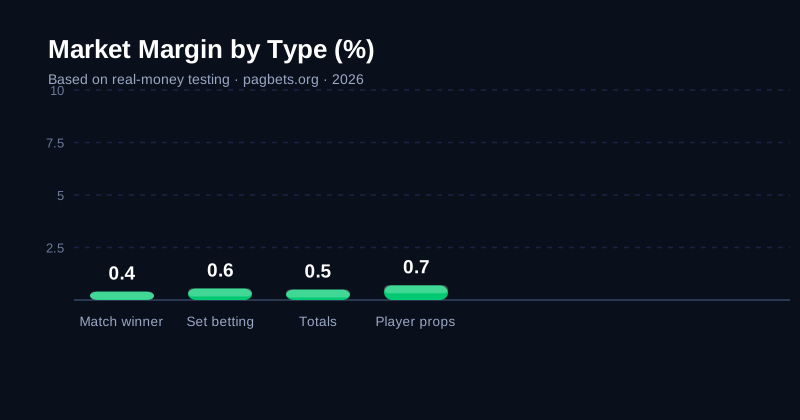
Match winner is efficient but fine for serious stakes. Set betting (correct score in sets) carries slightly higher margins yet frequently misprices the favourite's dominance level. Total games (over/under) is driven by serve quality versus return quality — very researchable. The genuine value tier is player props: aces, double faults, first-serve percentages. Bookmakers price props from generic models, and a bettor who knows that Player A's ace rate doubles on grass has a real edge.
- Match winner — liquid, efficient
- Set betting — misprices dominance levels
- Total games — serve vs return matchup
- Player props (aces, double faults) — least efficient, most research-rewarding
- Outright tournament markets — fun but high margin, treat as entertainment
The Research Routine for a Single Match
Thirty minutes per match, in order: surface-specific form (last 12 months, filtered by surface), head-to-head history weighted by surface, serve and return stats, recent fatigue (tournaments played in the last three weeks), and motivation (ranking points at stake, history at this tournament). Then — and only then — estimate your probability and compare it with the market. That single habit, applied consistently, is the difference between tennis betting and tennis research.
Live Tennis: Momentum You Can See
Tennis live betting is unique because momentum is observable: first-serve percentage slipping, a player favouring a leg, frustration after a break. The live price moves with the scoreline, but it lags the physical signals — bet between games, after you've watched the previous game's body language, not during points. One disciplined live bet per set is plenty.
Bankroll Rules for Tennis
Tennis betting volume can be high — tournaments run daily — so staking discipline matters more than usual. Flat-bet 1–2% of bankroll per match, cap yourself at a defined number of matches per week, and remember that even 55% match-winner accuracy at typical odds is only marginally profitable. Use our bankroll system unchanged; tennis needs no special maths, only special consistency.
Getting Started This Week
Pick one tournament, build your surface table, and paper-trade ten matches before risking money. When ready, open accounts at two bookmakers from our rankings (Bet365 for sharp prices, 1xBet for market depth), bet the props where your research shows the biggest gap, and log every bet with your pre-match probability estimate. Tennis rewards exactly this process — and punishes exactly its opposite.