
What Free Spins Actually Are
A free spin is a wager on a slot that the casino pays for, with conditions attached to whatever you win. The spins themselves are genuinely free — you do not lose your own money on them.
What is not free is the winnings. In the overwhelming majority of cases, any amount won during free spins becomes bonus funds rather than withdrawable cash, and must clear a wagering requirement before it becomes real money. The requirement is a multiple of the winnings, which means you have to wager considerably more than you won.
This is why two offers of 100 free spins can be worth wildly different amounts. The spin count is the marketing number; the wagering condition is the real one. Our casino bonus guide covers the underlying mechanics.
Stake Not Returned vs Stake Returned
The single most important distinction in free spins, and the one most players never encounter clearly explained.
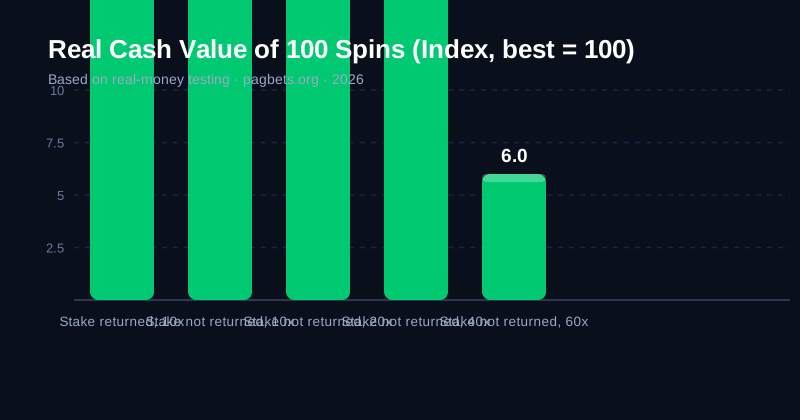
On a stake-not-returned free spin, the bet is deducted and only returned if the spin wins. A losing spin therefore costs you the full bet value for nothing. This is the standard format and it means the free spins are played at the game's normal house edge, with your only advantage being that the stake was not your own.
On a stake-returned free spin, the stake comes back on every spin regardless of outcome. Every free spin is then a genuinely zero-cost wager, which has a positive expected value. These are worth considerably more and have become much rarer, because they cost the operator real money. A 100-spin stake-returned offer at 10p is worth more than a 200-spin stake-not-returned offer at 50p, and the arithmetic is straightforward.
| Feature | Stake not returned | Stake returned |
|---|---|---|
| Losing spin cost | Full bet | Nothing |
| Expected value of spins | Positive but modest | Meaningfully positive |
| Availability today | Standard | Rare and often VIP-only |
| Best played on | High-RTP games to lift returns | Any RTP, more spins is better |
| Real value | Usually below cash equivalent | Can exceed cash equivalent |
The Wagering Requirement Is the Real Cost
Here is a worked example that makes the maths concrete. A casino offers 100 free spins at 20p each on a 96% RTP game, with winnings subject to 40x wagering.
The total wagered during the spins is £20. At 96% RTP, the expected return is £19.20 — an expected loss of 80p. If you happened to win £4.00, that £4.00 becomes bonus funds requiring 40x, meaning £160 of further wagering. At 96% RTP that expected returns £153.60, an expected loss of £6.40 on the requirement alone.
So a plausible result — winning £4 — leads to an expected loss of more than £6 when the requirement is cleared. The free spins had negative expected value, and this is typical rather than exceptional. The wagering requirement is not a formality; it is where almost all the value disappears.
- Total spins wagered is spins multiplied by bet value
- Expected return is that figure multiplied by the RTP
- Winnings become bonus funds, not cash
- Requirement applies to the winnings, at the stated multiple
- Clearing the requirement costs money, at the game edge
- Result: expected value is usually negative on the spins alone
When Free Spins Are Genuinely Worth Using
There are situations where free spins represent real value, and they are worth identifying precisely.
Stake-returned offers are the clearest case, because the expected value is positive and there is no cost to the spins themselves. Low-wagering requirements are the second: a 10x requirement on a modest win is clearable, while a 50x requirement is not. High-RTP games are the third, because the return on both the free spins and the subsequent requirement is higher than it would be on a 92% title.
There is also a case in which free spins are worth more than cash. If you would not otherwise have deposited, the offer converts a decision you were not making into a bonus, and even a negative expected value can be rational if the alternative is no play. That is a legitimate framing provided it is a genuine one.
Free Spins on No-Deposit Offers
No-deposit free spins deserve separate treatment, because they remove the deposit decision entirely and change the expected value in a way that is not always understood.
On a no-deposit offer, the only thing you are risking is your time, and the spins themselves are genuinely cost-free. That makes the decision to accept close to free even where the wagering requirement is high — a 100-spin no-deposit offer with a 50x requirement is still rational to take, because the downside is an hour of play and the upside is a withdrawalable balance.
The caveats are real. You are providing personal information to verify your identity before you can play, and that has a privacy cost even when it has no financial cost. Some operators apply country restrictions to no-deposit offers, so a player outside a supported region may simply not be able to complete verification. And the wagering requirement is still applied to winnings, so the practical conversion rate remains low.
The rule worth remembering: with no-deposit offers, accept generously, because your downside is genuinely small. With deposit-linked free spins, the arithmetic is much tighter, because the deposit is real money and the spins are worth less than the cash. Our loyalty and rewards guide covers the alternatives.
What a Free Spins Offer Reveals About the Operator
There is useful information in the free spins offer itself, well beyond its cash value.
A casino offering stake-returned free spins is paying real money for a product benefit, which is a rational thing to do and one relatively few operators can afford. It suggests a site that is confident in its games and in its retention economics — the offer is designed to bring you in and keep you playing rather than to extract a deposit quickly.
A large number of spins with a high wagering requirement suggests the opposite economics. The operator is offering something that looks generous while structuring it so the bonus is unlikely to be cleared, which keeps funds tied up and encourages continued play through the requirement. That is not dishonest — it is standard commercial practice — but it tells you what the site is optimised for.
Worth noting either way: the free spins offer is the most visible part of a casino's promotion, and the parts that matter for your money are the withdrawal terms and the licence. Our security checklist covers those, and it is worth running before any offer is accepted.
Practical Rules for Using Them
Read the terms before accepting, using our bonus terms checklist as a starting point. The five things that matter are the stake-returned status, the wagering multiple, the game weighting, the maximum bet cap during bonus play, and the expiry window.
Then choose the game deliberately rather than accepting the default. A high-RTP, low-volatility title is the right choice, because the requirement needs clearing with as little variance as possible. Playing a volatile game with bonus funds risks losing the balance faster than a steady game would, and the requirement does not care how you got there.
Finally, treat winnings as gone until the requirement is met. It is psychologically the hardest part, and treating a bonus balance as money in your account is what leads to disappointment.
- Check stake-returned status first, it changes everything
- Prefer a 10x–20x requirement, 40x and above is rarely clearable
- Choose a high-RTP, low-volatility game, not the default
- Respect the maximum bet cap, overshooting wastes progress
- Check the expiry window, short windows assume constant play
- Do not treat winnings as real money until cleared