Africa's Most Developed Betting Market
Nigeria stands apart in African betting for one reason: it has a real licensing framework. The National Lottery Regulatory Commission regulates national operations and state regulators license local operators — which means Nigerian players can choose licensed, locally accountably bookmakers rather than relying solely on offshore sites. That's a meaningful advantage for player protection. This guide covers the licensing picture, the payment reality, and our tested rankings for 2026.
Our Nigeria Rankings 2026
Weighed for Nigerian players — licensing, naira payment access and withdrawal reliability:
| Category | Best options | Why |
|---|---|---|
| Local licensed | Bet9ja, SportyBet | NLRC/state licensed, naira-native, USSD |
| International + crypto | 1xBet, Stake | Deepest markets, crypto rails |
| Premier League focus | Bet365 | Sharpest EPL odds + streaming |
| Aviator & casino | Mostbet | Crash games, crypto support |
Payments: The Local Advantage
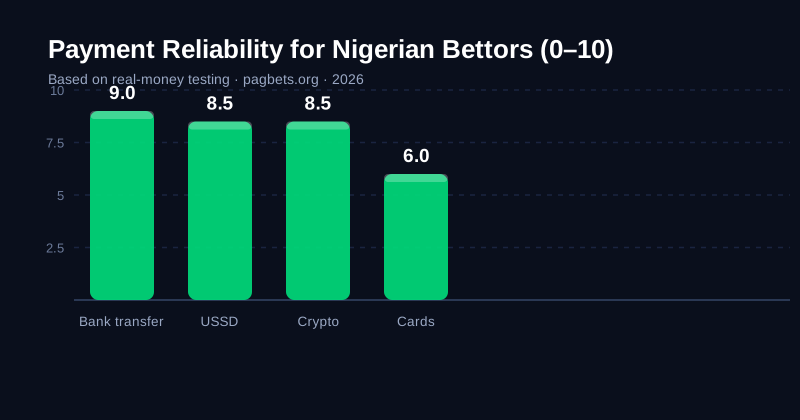
Nigeria's payment market rewards local operators. Bank transfer and USSD are the standard rails for licensed Nigerian bookmakers — instant deposits, withdrawals usually within 24 hours, all in naira with no conversion. Cards work where supported but can be inconsistent. Crypto (USDT) is the fastest international route and increasingly popular given Nigeria's leading crypto adoption rate. The practical strategy: use a naira-native operator for convenience and an international crypto-accepting one when you want deeper markets. Our payment guide has the measured comparison.
What Nigerian Bettors Bet On
Football dominates absolutely — the Premier League first, then the Champions League, La Liga and the Nigerian Professional Football League. Basketball (NBA) is the clear second, and the Aviator crash game has become a phenomenon with local players. Odds shopping matters: local and international operators price the Premier League differently enough that comparing two before every bet is a genuine free edge.

Choosing Safely
The checklist for Nigerian bettors: confirm the operator's NLRC or state licence for local sites, or the international licence at the regulator's register for offshore ones (our fake-site routine), test one small withdrawal before scaling up, and prefer naira-native rails where available. With licensing now formal, Nigeria's regulated operators offer protection that most of Africa's betting markets still lack — use it.
Where the Nigerian Market Actually Stands
Nigeria's gambling position is one of the least settled among large markets, and the practical answer differs from the legal one.
The national position permits gambling in some forms and prohibits it in others, and enforcement has never been uniform across the states that matter commercially. The result is a market where licensed international operators serve players and local rules do not prevent it. Our the India guide covers the neighbouring position, which is similarly unresolved.
Funding Is the Real Constraint
What limits a Nigerian player more than the law is the payment rails, and the available ones are narrow.
International cards fail frequently because of bank policy, and the local rails that do work do not typically pay out to a betting account. That combination makes withdrawal the hard part rather than deposit, which is the same structural problem described in our the payments guide. An operator with a strong deposit experience and a weak withdrawal process has solved the easier half of the problem.
Tax on Nigerian Betting Winnings
Nigerian players are right to be unclear about tax, because the position has never been set out cleanly and the gap between a formal obligation and an informal one is doing a lot of work in the discussion. The starting point is that the National Lottery Regulatory Commission's regime contemplates tax on winnings above a threshold, and that local operators deduct at the point of withdrawal. International operators serving Nigerian customers generally do not deduct, and the obligation then sits with the individual rather than the operator.
That asymmetry is what makes the topic confusing. A player winning on a locally licensed book may have tax deducted automatically without noticing, while the same player winning at an offshore operator pays nothing at withdrawal and receives no deduction receipt. It is reasonable to treat those as different situations rather than assume the offshore result is the correct one. Our tax on winnings guide sets out how deduction works in the markets where a threshold exists.
Keep records regardless of the answer, because the two documents that matter are trivial to produce and impossible to produce later. A per-bet statement showing selections, stakes and returns, and a per-withdrawal statement showing amount and method, together tell the whole story. Anyone who has run turnover into the tens of millions of naira across a season should expect to be asked which bets produced the balance, and the operator's own export is the easiest evidence to produce.
The honest criticism of the current arrangement is that it discourages the paper trail. Where deduction is automatic, nobody keeps records because nobody needs to; where it is not, keeping records costs effort and gains nothing visible until it is needed. If a Nigerian player takes one practical step from this section, make it the record-keeping. Our bookmaker selection guide covers choosing operators that issue proper account statements.
One practical question worth asking any operator: does it issue a per-withdrawal tax statement, and does it confirm whether tax was deducted? That single question distinguishes an operator that has considered the question from one that has not, and the answer tells you what your records need to contain if you are asked later. Our licence guide explains why that differs between regulators.
Mobile Betting on Nigerian Networks
Nigerian mobile data is cheap and mobile broadband is widespread, which means the practical constraint on betting from a phone is not cost per megabyte but connection stability. A live bet needs a round trip to the operator on every odds request, and a two-second stall on a congested network is the difference between a bet accepted at 1.85 and a rejected bet. More disputes we have seen originate from connection failures than from incorrect picks.
Operators built for markets like this offer a lite or app-based version rather than the full desktop site, and the difference is substantial. Lite versions ship a fraction of the data — commonly 1.5 to 3 MB against 18 MB or more for the full site — and pair with the SMS or USSD route for deposits, which needs no data at all. The lite product is not a stripped-down compromise; in our testing it is the product most of the market actually uses, and operators optimising for Nigeria prioritised it accordingly.
Data cost is a real constraint at scale. A bettor placing 40 bets a week on the full site consumes roughly 700 MB a week, which is negligible on fibre and material on a metered mobile plan. The lite product cuts that to about 60 MB. The calculation is unglamorous but it decides the real budget: at roughly 1.50 dollars per gigabyte the difference is under a dollar a week, which is why we treat data as a minor factor and connection stability as the major one.
The bigger mobile question is which device. Our mobile betting guide covers platform differences across operators, and our casino app rankings cover the same ground for the game lobby. For Nigerian players the deciding factor is not screen quality but whether the app handles a dropped connection gracefully — an app that freezes rather than showing a retry leaves you with no record of whether your bet went in at all.
Backup matters more than speed. Any operator worth using lets you place a bet through a second route when the app fails — an SMS command, a USSD code, or a lightweight browser page that does not need an install. Sites built for markets with intermittent connectivity provide all three, because they expect the connection to fail. Our ranked betting sites page records which operators offer a genuine fallback rather than a reinstall prompt.
Esports, Virtuals and Where Nigerian Volume Has Moved
The fastest-growing part of the Nigerian market is not football. Virtual sports and esports now account for a substantial share of stakes at several local operators, and the reason is structural rather than faddish: virtual football runs 24 hours a day with a result every three minutes, it needs no live data feed to price sensibly, and it does not stop at half-time.
For a player betting in the margins of a working day, that cadence converts a market they cannot afford to follow into one they can play in short sessions, which is a genuine reason for the growth. The economics are unfavourable and should be stated plainly. A virtual football result is produced by a random number process priced with a margin typically between 4 and 8 percent, wider than a football market on a real fixture. Esports markets price closer to sports, at 3 to 5 percent, but the cut-off is sharp.
Our sportsbook margin guide explains why a wider margin needs a shorter game to be worth playing, and virtual sports with their high turnover are exactly that case. Players turning over a large volume of small stakes convert a 6 percent margin into a very fast bleed. The crash and virtual products at operators such as Mostbet are the same economics wearing a different costume, and our volatility guide covers the shape of it.
There is one legitimate use, and it is not the obvious one. Esports markets at bookmakers such as Betway and Bet365 carry genuine pre-match prices sharp enough to trade, and our rating methodology scores niche-sport depth rather than ignoring it. Beyond that, our advice to Nigerian players is to keep the bulk of turnover on real sports at a 2 to 4 percent margin and treat virtuals as entertainment bought at a known price.
There is a real discipline available in the virtual markets, and it is not the one most players attempt. Virtual football rounds are independent, so a losing run means nothing about the next round, and treating them as connected is the single most common error. Our volatility guide covers why independence makes chasing behaviour worse rather than better, since each extra round is simply another 6 percent margin purchase.
✓ What We Like
- Tells you how to check a licence rather than asking you to trust one
- Covers the payment problem that decides whether the product is usable for you
- Explains the tax structure, which is the part that sets the price
- Uses named regulators, laws and figures rather than general description
✕ What Could Improve
- The cheaper alternative is unprotected, and the article is honest about that
- A limit or ceiling constrains how much you can actually stake