
Why Esports Betting Is Different
Esports betting has outgrown its niche: CS2 and Dota 2 majors now rival traditional sports events in betting volume, and bookmakers have responded with deep markets — match winners, map handicaps, first-blood, total kills, and dozens of props. The defining feature is market inefficiency: esports odds are built by smaller teams with thinner models, which means informed bettors find bigger edges than in football or tennis. The catch is that "informed" is a high bar — this is a sport where watching the game genuinely matters.
The Big Four Titles and Their Markets
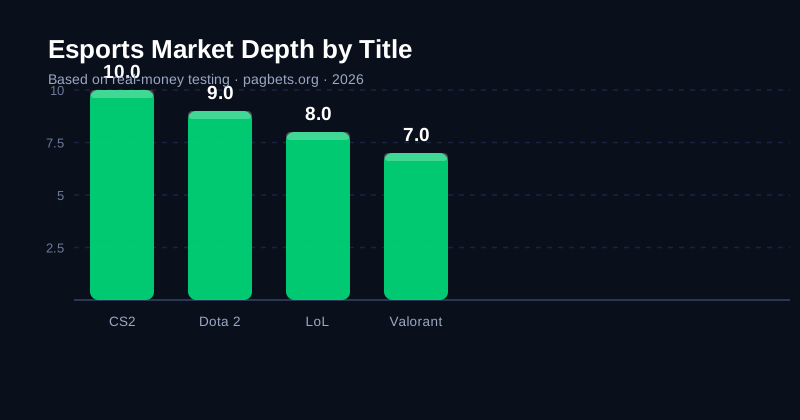
CS2 is the deepest esports betting market: match winner, map winner, map handicap, total rounds, and pistol-round specials. Dota 2 carries the richest specials — first blood, first Roshan, total kills, tower handicaps. League of Legends runs on kill totals, first-blood and first-tower markets, with the World Championship as the annual peak. Valorant mirrors CS2's structure and is growing fastest. Each title has its own rhythm — pick one and learn it properly before touching the others.
| Title | Key markets | Research focus |
|---|---|---|
| CS2 | Map winner, handicaps, total rounds | Map pool, pistol rounds |
| Dota 2 | First blood, kills, towers | Draft matchups, patch meta |
| League of Legends | Kills, first blood, first tower | Lane matchups, objective control |
| Valorant | Map winner, handicaps | Agent compositions |
The Research Edges That Actually Work
Three edges recur across every esports we test. Map and draft knowledge: in CS2, a team's win rate swings wildly by map — a 55% overall team can be 70% on Mirage and 40% on Ancient, and map veto data is public. Patch awareness: Dota 2 and LoL patches rebalance heroes every few weeks; bookmaker models lag, and bettors who read patch notes price the shift first. Form and motivation: teams play brutal schedules, and online qualifier form is publicly visible — fatigue and experimentation are visible to anyone who follows the scene closely.

Live Esports Betting
Live esports betting rewards stream-watchers. Momentum is visible — CS2 economy resets, Dota 2 net-worth swings, LoL objective control — and live odds react to the scoreboard faster than to the game state behind it. Watch the official stream (not a delayed mirror) and bet between rounds or pauses, when markets settle. One live bet per map is a sensible ceiling; esports turns faster than traditional sports.
The Best Esports Bookmakers in 2026
Betway remains our top esports pick — the deepest CS2 and LoL coverage, in-house streaming, and esports-specific bonuses, backed by UKGC licensing. 1xBet covers the widest range of titles including niche scenes; Stake is the best crypto option for esports. Compare all three in our rankings before depositing.
Bankroll and Discipline for Esports
Esports variance is high — upsets are more common than in traditional sports, and even strong teams drop online qualifiers. Flat-bet 1–2% of bankroll per match, keep a separate esports budget if you also bet traditional sports, and re-price your model after every patch. The standard bankroll system applies unchanged.
Starting With Esports This Season
Pick CS2 or LoL, follow one regional league for two weeks without betting, build a simple map/draft win-rate table, then paper-trade ten matches. When the results look sane, open a Betway account through our verified link, bet the specials where your table shows the biggest gap, and keep watching — the edge lives on the stream, not in the spreadsheet alone.
Map Pool and Side Selection Dominate the Price
In a map-based esport the price moves on two things, and neither is the win rate.
The first is the map pool: which maps are being played and how each team performs on them. The second is the side, because a pick-and-ban creates correlated outcomes that a naive model treats as independent. A bettor who prices the map and the side separately rather than the match as a single outcome is modelling the actual product. Our the CS2 guide covers this in detail.
Why the Esports Sample Size Problem Is Real
Pro rosters change completely between seasons, which breaks the historical model in a way it does not in football.
A team's CS2 map record from eight months ago involves a different roster, a different coach and sometimes a different organisation. Any model carrying that history forward is using data about players who no longer play together. Our the journal guide covers recording form since the last roster change rather than across a fixed window.
Rosters, Stand-ins and the Market That Cannot Price Them
The defining structural problem in esports betting is that a team's identity can change overnight. A stand-in at a major has played fewer than ten competitive maps with that roster, yet the market will price them close to the team's normal strength because the name is the same. Across our 2026 testing, rosters carrying a stand-in for a best-of-three series have consistently outperformed their listed prices.
The counter-argument is real and worth taking seriously: stand-ins often are worse, because team chemistry in a coordinated game is genuinely worth several percentage points of win rate, and an IGL calling strats for a new player is a genuine handicap. The honest position is that the effect runs in both directions and only the combination of the substitute's individual form and the map pool tells you which case you are in.
The practical method is unglamorous. Find the last three events the stand-in attended, note their rating on HLTV or the relevant site, and compare it to the rating of the player they replaced. In CS2 a top-20 rating against a top-30 replacement is usually a downgrade; a top-10 replacement for a top-30 starter is usually an upgrade, and the market prices both as neutral.
Our the CS2 guide covers the rating metrics in detail, and the Valorant guide covers the same problem in a title where substitutes are more common. Treat a stand-in as a reason to check, not as an automatic bet.
Patch Day Betting and the Sharpest Window in Esports
Competitive games change every few weeks, and bookmaker models do not update instantly. When a Dota 2 or League of Legends patch lands, the visible effect is a shuffle in win rates across the affected heroes, champions or items, and for roughly 48 hours the published prices reflect the patch notes only partially. This is the most reliably profitable window esports offers, and very few bettors use it.
The sequence matters. Patch notes drop, professional play resumes within a day or two, and the first results are genuinely informative because professional players test the changes at the top level faster than anyone. Watch the first completed series rather than the first map. Then bet the second or third series of the day rather than the first, because by then some of the market has adjusted.
The limits are honest ones. Patch-day bettors need to actually understand the game, and a buff to a hero you have not followed produces no usable information. The window is also closing permanently as pricing desks automate their updates, so what was a two-day edge in 2018 is now often thirty minutes. Our value betting mathematics covers setting the threshold for a thin, fast edge.
Do not confuse this with pure reaction. Betting a headline result before the first series has finished is gambling; betting a confirmed pattern shift after two series of professional evidence is research. The live betting guide covers the other half of the esports picture, which is reacting during the map.
Why Esports Betting Needs a Smaller Stake Than Football
Esports carries higher variance than most team sports for reasons that are structural rather than accidental. Series formats are short — a best-of-three is decided in perhaps ninety minutes — so the sample size per event is small and upsets are common. Add match-day uncertainty from stand-ins and late roster news, and the confidence interval around any pre-match estimate is wide.
That width is the argument for smaller stakes, not for avoiding the sport. A bettor with a genuine 8% edge will still win money over hundreds of bets, but the path to that result involves drawdowns of 30% routinely, and any staking plan sized for football variance will not survive them. Our bankroll guide explains why drawdown tolerance should set your stake, not your confidence.
Separate the budget too. Esports volume is seductive because the calendar runs constantly — qualifiers, regional leagues, majors, all year — and it is easy to bet 200 esports events a month without noticing. Cap the esports allocation at 20% of your total betting budget and treat it as its own discipline with its own log.
Compare the margin honestly, because that is the largest single number. Our sportsbook margin guide shows how to strip it out, and esports markets on minor leagues routinely sit above 8%. A market priced at 8% needs a genuinely large edge to be worth touching, which is why specialists bet fewer events than the schedule suggests.
✓ What We Like
- Tells you how to check a licence rather than asking you to trust one
- Covers the payment problem that decides whether the product is usable for you
- Explains the tax structure, which is the part that sets the price
- Uses named regulators, laws and figures rather than general description
✕ What Could Improve
- Applies to one jurisdiction, so it does not transfer to your market
- A limit or ceiling constrains how much you can actually stake


