Two Very Different Games Called Poker
When a casino lists 'poker', it usually means one of two quite different things. The first is casino table poker — three card poker, pai gow poker, stud poker and similar variants that resolve in seconds with no decisions required from you. The second is skill-based poker — Texas hold'em and Omaha — where the game is genuinely competitive and your decisions determine the result.
These attract very different kinds of money. Casino table poker is priced with a built-in house edge, similar to a slot. Skill-based poker is closer to a card game, and the edge at those tables comes from a mix of structural rules and the small number of very strong regulars.
How the Main Markets Work
In three card poker you receive three cards and can fold or raise, and the dealer qualifies in a ranked order: straight flush, three of a kind, straight, flush, high card, then play. The decision to raise is a genuine choice with a real expected value, and the standard play is to raise with a hand of jack or better, and to bluff a small percentage of weaker hands at the right moment.
In pai gow poker you receive seven cards and form the best possible five-card poker hand, leaving two unused. The rule that catches out beginners is that the five-card hand must win and the two-card hand must lose. Putting your best pair in the five-card hand instead of the two-card hand is the single most common avoidable mistake.
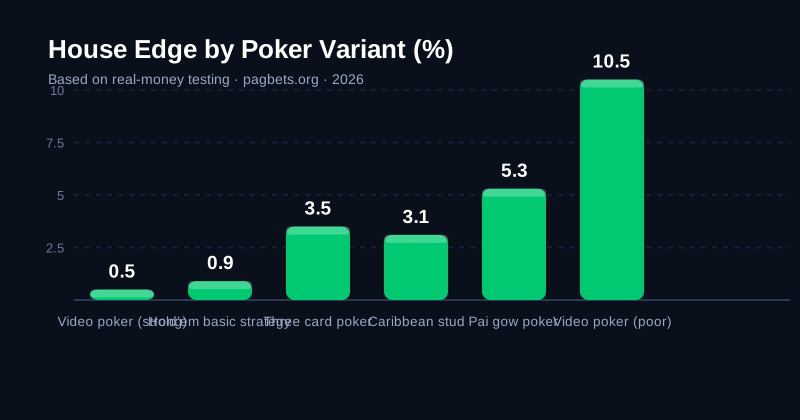
| Game | House edge (typical) | Skill ceiling | Best for |
|---|---|---|---|
| Three card poker | 2% – 7% | Low | Quick, low-pressure play |
| Pai gow poker | Around 5.3% | Low to moderate | Relaxed play with some decisions |
| Video poker | 0.5% – 10%+ | High with study | Players who want to improve |
| Caribbean stud | Around 3% | Low | Simple progressive side games |
| Texas hold'em cash | Under 1% | Very high | Serious, competitive players |
Odds to Know Before You Play
The odds follow from the pay table, which is why the same game can have a very different edge at different casinos. In three card poker, a common pay schedule pays 1:1 on a pair, 2:1 on a three of a kind, 3:1 on a straight and 8:1 on three of a kind with a side bet. Those odds are fixed and knowable before you play.
The practical rule is to find the pay table before you sit down, and to check whether it is generous. A poor pay table on an otherwise good game quietly converts a modest edge into a substantial one, and no amount of strategy compensates for a schedule that pays you less than the odds justify.
Side Bets and Their Real Cost
Side bets are the main source of unexpected losses in casino poker. The pair plus market, the blackjack bonus, the six-card bonus, high card and the progressive jackpots all pay on events that are much less frequent than they appear, and the prices usually reflect that. The problem is not that any single side bet is unfair — it is that they are add-ons, so the only way to play them is to stake extra.
Card-based side games deserve a specific warning. Blackjack bonus, three card poker bonus and pai gow bonus are essentially lotteries attached to a card game. They are priced generously enough to be tempting, and the effective house edge on them is commonly far higher than on the base game. They are fun for an occasional punt, and unsuitable as part of anything you would call a plan.
- Read the pay table first — odds follow from it directly
- Check the house edge for the specific game and schedule
- Treat side bets as entertainment, not strategy
- Never raise to 'chase' a progressive — it does not change the odds
- Learn pai gow's five-and-two rule before playing it seriously
- Set limits with our responsible betting tools guide before playing
Reading the Cards Quickly
Speed matters less than accuracy, but it matters. In three card poker the decision tree is short: raise with jack or better, raise with a king and a side bet on, bluff two low cards against a weak qualifying hand a fraction of the time. In pai gow, the hand-splitting logic takes a little more practice, and the most common errors are putting an overpair in the two-card hand when it would be better in the five.
Video poker is the one variant where deliberate study genuinely pays. Because the pay table is fixed and published, you can work out the ideal play for every hand over time, and the returns on a well-played machine exceed almost every other casino game. Our RTP guide explains how return percentages are calculated and why they vary so much between games.
Where Casino Poker and Skill Poker Diverge
The distinction matters more than most players realise, because the two categories carry very different expectations. Casino table poker is a priced game with a mathematical edge against you. You can reduce that edge with strategy, and in three card poker the reduction is meaningful, but you will never be playing the same situation against the same opponents twice.
Skill-based poker is different in kind. In a large field of online hold'em, your edge comes from a mixture of study, table selection and discipline, and it is genuinely achievable — though it takes years rather than weeks. The number of players who beat the rake consistently is small, and the number who believe they will be among them is much larger.
It follows that a beginner should not attempt the same approach to both. A casino poker player benefits from tight rules and fixed stakes, because variance and time are their enemy. A hold'em player benefits from study and selectivity, because the volume of hands played works against them. Adopting the wrong approach for the game you are playing is one of the more expensive mistakes available, and it is entirely avoidable.
Whichever category you choose, the fundamentals of money management are the same, and they are covered in detail in our bankroll management guide.
Bankroll Management at the Poker Table
Poker is the one casino-adjacent game where bankroll management genuinely runs the other way: you need far more buy-in than your stake size suggests. Standard guidance for cash play is a minimum of thirty times your big blind, and considerably more if you play at a table where the blinds rise quickly.
The reason is ruinous variance rather than a steady loss. A competent poker player will lose entire buy-ins regularly, because the distribution of results in a high-variance game has a long tail. Someone who buys in for five big blinds and plays competently will bust out early and often. Someone who buys in for thirty will absorb the same losses and continue playing, which is the entire point of the number.
This is a genuinely different skill from the staking discipline described elsewhere on this site, and it is worth reading our bankroll management guide alongside it. The shared principle is that both games punish the player who treats a bad run as something to be escaped rather than absorbed.
A Sensible Way to Approach Poker
Start with one game and learn it properly rather than sampling five. If you want the shortest path to a reasonable return, pick a video poker title with a generous pay table and play it with strategy. If you prefer the pace and atmosphere of a table, learn three card poker's decision rules before you play for money, and stay away from the side bets while you are learning.
Whatever you choose, set the budget first. The most common way people lose at poker tables is not poor card play but playing several tables at once, staking more than intended, and treating every round as a decision to continue. A fixed session limit resolves most of that without any change to your strategy.