
The Promotion Everyone Loves — And Rarely Prices
Odds boosts are the most popular promotion in betting: the bookmaker takes a selection and raises its price, and every player feels they're being handed value. Sometimes they are. Often the boost simply closes the gap to what a sharper bookmaker already offers — which is marketing, not generosity. This guide explains the four boost types, the maths behind each, and the three-step test that takes ten seconds and tells you whether a boost is real.

The Four Boost Types
Price boost: a single selection's odds rise — 2.00 becomes 2.40. Acca boost: winnings on accumulators increase by a percentage tiered by legs (5% at four legs, up to 50%+ at eight). Profit boost: your profits rise by a percentage after settlement, often across a market rather than one selection. Free bet / stake back: not strictly a boost, but the same marketing family. Each carries different caps and restrictions — read them in that order before claiming.
| Boost type | How it pays | Typical cap | Value quality |
|---|---|---|---|
| Price boost | Higher odds on one selection | Small max stake | Variable — compare market |
| Acca boost | % added to acca winnings | Legs required | Good if legs are value |
| Profit boost | % added to profit | Market-wide | Usually the cleanest |
| Stake back | Refund as free bet | Event-specific | Good if terms are clean |
The Maths: What a Boost Actually Adds
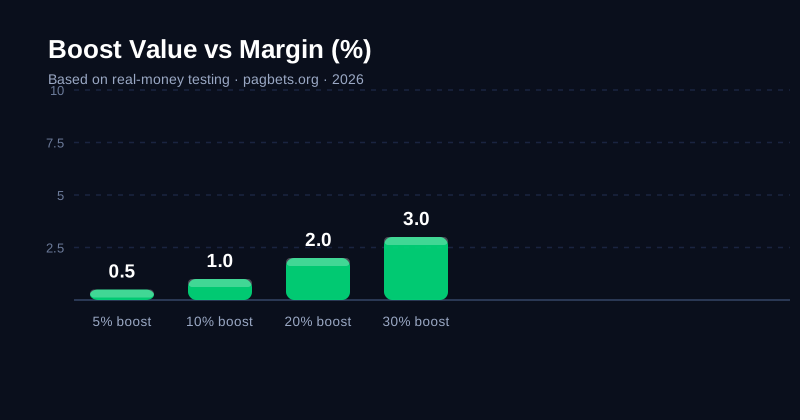
A boost's value depends on where it takes the price relative to the market. Example: a selection is priced 2.00 everywhere, and one bookmaker boosts it to 2.40. That's a genuine 20% profit lift — if it beats every other bookmaker's price, you've captured real value.
Now the common trap: the same selection is available at 2.45 at a sharper bookmaker, and the boost lifts the slower site from 2.10 to 2.40. The boost feels big, but the boosted price still loses to the market. Never value a boost against the same bookmaker's own price — value it against the best price available. Our odds guide explains how to read the market quickly.
The Three-Step Boost Test
Ten seconds, every time:
- 1. Compare: check the boosted price against the best price at two other bookmakers
- 2. Check the cap: find the maximum stake — that number is where the value ends
- 3. Read the terms: minimum odds, market restrictions, and whether the boost applies to stake or profit only

Acca Boosts: Good Maths, Bad Habits
Acca boosts are the most attractive-looking promotion because the percentages scale dramatically — 50% extra on an eight-fold is headline material. But the underlying maths is unchanged: each added leg adds margin, and a 50% boost on a wager you'd never place without the promotion is still a bad bet. The disciplined use: build accumulators you'd genuinely back, then take the boost as a bonus. Our acca guide covers the underlying maths.
How to Use Boosts Well
Boosts work best as tie-breakers, not decision-makers. The routine that holds up: keep your shortlist of two or three bookmakers from our rankings, check the day's boosts before placing your normal bets, use boosts on selections you'd already back, and never increase stakes because a boost exists. Used that way, boosts add a genuine few percent to your long-run returns — the only promotion in betting that reliably does.