The Same Casino, Faster Rails
Strip away the novelty and a Bitcoin casino is a standard online casino that settles in cryptocurrency: the slots, tables and maths are identical to fiat casinos. What changes is the rails — deposits confirm in minutes, withdrawals in seconds rather than banking days — and one genuinely new capability: provably fair games, whose results you can verify cryptographically instead of trusting an auditor. This guide explains the mechanics, the security responsibilities and what separates good crypto casinos from risky ones.
The Payment Flow
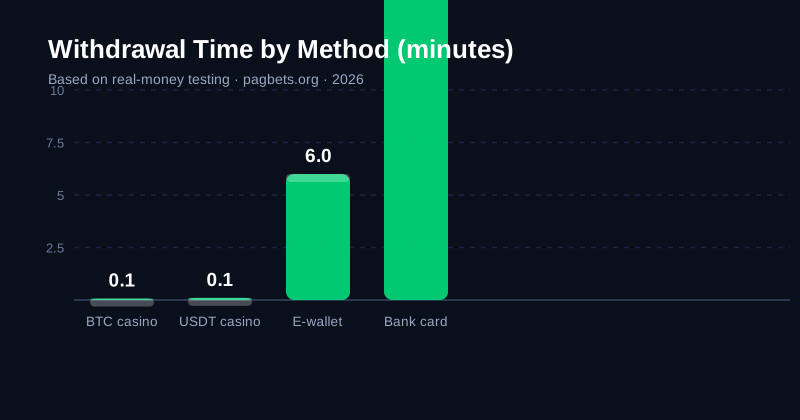
The Bitcoin casino loop: buy BTC or USDT on an exchange, move it to your own wallet, deposit to the casino (copy the address, confirm the network, send — credited in minutes), play, then withdraw back to your wallet. The withdrawal is the headline advantage: our measured Bitcoin withdrawal at Stake took 40 seconds — no pending periods, no bank processing days, no chargeback bureaucracy. Our payment guide has the complete measured comparison.
- Buy coin on an exchange → move to your own wallet → deposit to casino
- Deposits credit in minutes; withdrawals settle in seconds to hours
- Always confirm the network (BTC vs USDT-ERC20 vs USDT-TRC20)
- Never deposit from an exchange directly — exchanges flag gambling transactions
Provably Fair: The Crypto Difference
Provably fair gaming is the format's genuine innovation. Before each round, the casino commits to a server seed; your client contributes a seed too; after the result, you combine both through a public hash and confirm the outcome was predetermined and untampered. Stake Originals (Dice, Crash, Plinko, Mines) all support verification in two clicks. A fiat casino asks you to trust the auditor; a crypto casino lets you check the maths yourself. Run the verification once — understanding the mechanism changes how much you trust everything else.

The Security Layer That's Entirely Yours
Crypto casinos shift one risk squarely onto you: self-custody. The casino can't refund a mistaken address, reverse a transaction, or recover a wallet whose seed phrase is lost — the blockchain's irreversibility cuts both ways. The non-negotiables: two-factor authentication on both wallet and casino account, seed phrase stored offline (paper, never screenshots), and a dedicated betting wallet holding only your gambling bankroll. The operator risks are unchanged from fiat; the wallet risks are new and belong to you alone.
Choosing a Bitcoin Casino
Apply the same checklist as fiat — licence verified at the regulator, payout history, game fairness — plus crypto-specific checks: which coins are supported, whether withdrawals are genuinely instant, and whether the operator has a provably fair offering. Our casino rankings run all of these; Stake remains the reference crypto casino, with 1xBet and Melbet as solid hybrid options. Full comparison in our crypto betting guide.
Related reading: our Casino Comps Guide guide covers the same ground from a different angle.
Related reading: our Online Casinos in Italy guide covers the same ground from a different angle.
Related reading: our Poker Bluffing guide covers the same ground from a different angle.
Related reading: our Scratch Cards Explained guide covers the same ground from a different angle.
What a Deposit Actually Costs: Networks, Fees and Memos
Nobody talks about what a crypto deposit costs, and the answer decides whether a player keeps 99% of their stake or 85% of it. Sending USDT on the Ethereum network can burn $8–25 in gas at busy times, while the same transfer on Tron typically costs under $1. That is not a rounding error on a $20 deposit — it is a 50%+ haircut on a small balance. Check the network the casino's cashier page specifies, and check it a second time before signing.
Two more costs catch newcomers out. Deposits sent from an exchange that has gambling transactions on its internal risk list may be frozen pending compliance review, sometimes for days, which is why the sensible route is exchange to personal wallet to casino address. And some networks require a memo or tag alongside the address; a transfer sent without it arrives as an uncredited balance at the other end. Our USDT guide sets out the network comparison in full.
Bitcoin, USDT or Ether: Choosing a Coin for Casino Play
Bitcoin is the headline, not always the best instrument. Volatility is the reason: a 10% BTC swing between deposit and withdrawal can erase several sessions of edge on a small stake, and a player converting back to fiat at the wrong moment pays that volatility out of pocket. Stablecoins such as USDT and USDC remove the price risk almost entirely, which is why most sharp crypto casino players hold their bankroll in stablecoins and treat Bitcoin as a funding source rather than a betting currency.
The trade-off runs the other way for larger balances. A player moving $5,000 who values privacy and asset ownership may prefer BTC, accepting volatility in exchange for no counterparty. Either way, the practical rule is unchanged: withdraw to your own wallet, never back to the exchange that funded the deposit. The mechanics differ from sportsbook deposits described in our crypto betting guide, where settlement rules rather than network choice dominate.
RTP and Game Selection: Reading a Crypto Lobby Properly
Crypto lobbies look enormous — 6,000+ games at the larger operators — and the number is largely noise. What matters is the weighted return to player across the games you actually play, weighted by volume. An operator advertising a 99% average across a catalogue where 80% of play sits on 96% slots is selling you a number that will never touch your session. Filter the lobby to the providers you use, check each title's published RTP, and work out the real average yourself.
Volatility deserves the same attention. A 96% slot with 25x volatility needs roughly 400 spins to express its edge; a 96% slot at 100x volatility needs 1,000. Before you complain that a session felt unlucky, check how many spins the game actually delivered per hour at your stake size. For games where pace and decision frequency genuinely change the maths, our live casino guide covers the format in detail.
Licensing: Who Actually Regulates a Bitcoin Casino
Because gambling is broadly illegal online in most jurisdictions, crypto casinos usually hold licences from offshore regulators — Curacao, Anjouan, Kahnawake in Canada, or the Autonomous Republic of Nauru. These are real licences with real compliance obligations, but their dispute resolution is slower and less binding than a UK Gambling Commission or Malta Gaming Authority regime. The honest position: an offshore licence is meaningfully better than no licence and meaningfully weaker than a tier-1 one.
What the licence does not cover is the wallet holding your funds before you withdraw. That is why the reference test in our responsible gambling tools guide applies: confirm the account carries functioning limits, self-exclusion and reality checks, because with no local ombudsman those tools are often the only friction standing between a bad night and a bad month. Verify the licence number on the regulator's own register, exactly as we do in our site rankings.
Why Crypto Casinos Draw a Specific Kind of Player
A crypto casino is not a faster version of a traditional one. It is a different withdrawal architecture, and it suits a specific player.
Withdrawals settle to a wallet rather than through a banking intermediary, which removes a category of delay and reversal entirely. The player it suits is one who already holds crypto and does not want to route funds through a bank that may decline the transaction. The player it does not suit is anyone who wants a dispute route, because a wallet transfer is effectively irreversible.
Our the crypto payments guide covers the mechanics, and the crypto betting guide covers how the tax position differs from card funding.
The Real Risks Are Counterparty and Key Management
The risk in a crypto casino is not usually the game. It is who holds the withdrawal.
An unlicensed operator holding your balance in its own wallet is the same counterparty risk as any unlicensed operator, with less recourse. On the player's side, the practical risk is key management: a private key that is lost, exposed or held by someone else cannot be recovered by anyone. Neither risk is unique to crypto, and both are worse than they look to someone treating crypto as a payment method rather than a custody arrangement.
✓ What We Like
- Tells you how to check a licence rather than asking you to trust one
- Covers the payment problem that decides whether the product is usable for you
- Explains the tax structure, which is the part that sets the price
- Uses named regulators, laws and figures rather than general description
✕ What Could Improve
- The cheaper alternative is unprotected, and the article is honest about that
- A limit or ceiling constrains how much you can actually stake